HiRISE Reveals Mars' Acidalia Planitia: Where Sci-Fi Meets Scientific Reality


Astro Information
HiRISE Reveals Mars' Acidalia Planitia: Where Sci-Fi Meets Scientific Reality

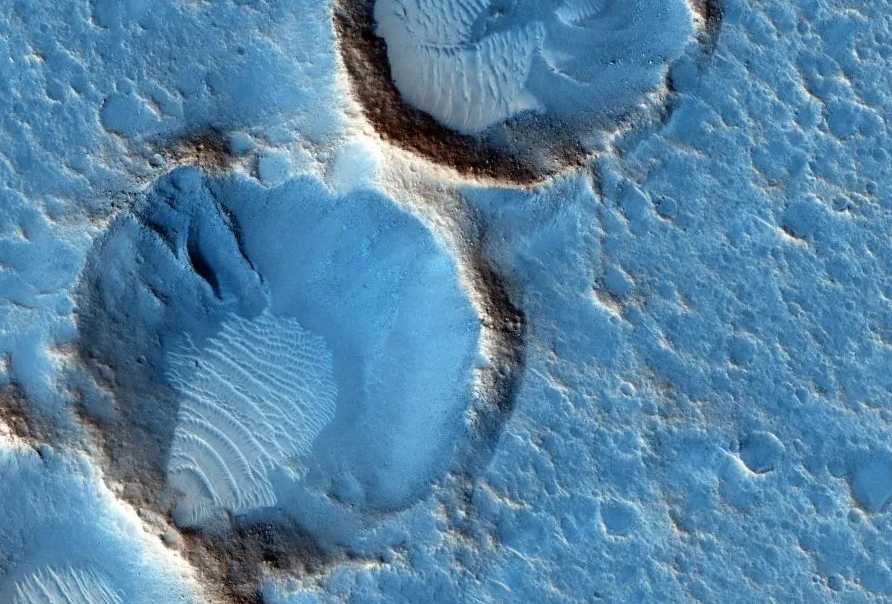
A close-up from NASA’s Mars Reconnaissance Orbiter (MRO) HiRISE camera unveils the weathered craters and aeolian features of southern Acidalia Planitia. While standard HiRISE imagery often appears in striking blue tones—a result of multispectral processing to enhance geological details—the region would likely appear gray or pale red to human eyes. Of course, no human has yet witnessed this Martian landscape firsthand—unless we count Andy Weir’s fictional NASA astronaut in The Martian.

Sci-Fi Ground Zero: Ares 3’s Fictional Landing Site

Weir’s novel places astronaut Mark Watney’s stranded mission at "Ares 3," whose fictional coordinates align with the cropped HiRISE scene. Watney’s 6-meter-diameter habitat module would measure just one-tenth the width of the largest crater in this image—a humbling scale comparison. Intriguingly, the imagined Ares 3 site lies ~800 km from the real-world Carl Sagan Memorial Station, where NASA’s 1997 Pathfinder lander touched down, bridging fiction and scientific history.

Geological Tales in the Martian Dust

The landscape tells a story of cosmic collisions and wind-driven erosion:


  • Impact Craters: Ranging from fresh, sharp-rimmed craters to ancient, degraded basins, these scars record billions of years of asteroid strikes.
  • Dune Fields: Sinuous dark ridges are barchan dunes, shaped by prevailing winds that sweep iron-rich dust across the plains.
  • Layered Deposits: Subtle color variations hint at sedimentary layers, possibly formed by ancient water or volcanic activity.


HiRISE’s 0.3-meter/pixel resolution reveals features as small as a picnic table, allowing scientists to study Martian geology in unprecedented detail.

When Fiction Inspires Reality (and Vice Versa)

The Pathfinder mission, which deployed the rover Sojourner, predated The Martian by two decades but shares thematic ties: both explore human resilience on Mars. Watney’s reliance on botanical ingenuity mirrors real-life plans for Martian agriculture, while the Ares 3 site’s proximity to actual landing zones highlights the scientific plausibility Weir infused into his story.


"Astronauts may one day walk where Watney ‘survived,’" says Dr. Alfred McEwen, HiRISE principal investigator. "HiRISE data helps mission planners identify safe landing zones and resources like subsurface ice—just as The Martian imagined."

The Color Conundrum: Why Mars Isn’t as Red as We Think

HiRISE’s blue-tinted images serve a scientific purpose, not artistic license:


  • False Color Processing: Infrared and visible light bands are combined to distinguish minerals—blue might represent basaltic rocks, while red signals iron oxides.
  • True Color vs. Perception: Mars’ iconic red hue comes from iron oxide (rust) in surface dust, but large-scale landscapes often appear tan or gray under the planet’s thin, dusty atmosphere.


As humanity prepares for crewed Mars missions, images like this bridge the gap between scientific data and popular imagination—reminding us that the line between a fictional astronaut’s survival story and real-life exploration is as thin as Mars’ atmosphere, yet as profound as the Red Planet itself.
Latest Stories
Bird Information1 minute readEndemic to New Guinea, the greater bird of paradise (Paradisaea apoda) belongs to the Paradisaeidae family, feasting on fruits and insects. So extraordinary is its beauty that 19th-century European naturalists doubted its existence, suspecting its vividly plumed specimens were fraudulent "mythical creatures."
Health News1 minute readSwitzerland has claimed the top spot in the latest European Health Consumer Index, solidifying its reputation as a leader in healthcare excellence across the continent.
Beauty News1 minute readMadrid-born freelance model Clara López, 27, has gained viral attention with a set of candid life photos captured across Barcelona’s cobblestone streets. The unposed series, shot by photographer friend Lucas Martínez, highlights López’s effortless elegance in everyday moments—from sipping coffee at a sidewalk café to browsing a vintage bookstore. Her 175cm frame, dressed in high-waisted jeans and oversized knit sweaters, blends seamlessly with the city’s bohemian vibe.
Travel News2 minute readNestled in the Vosges Mountains of Haute-Saône, France, the Plateau des Mille Etangs (Thousand Ponds Plateau) is emerging as a top destination for discerning hikers. Shaped by glaciers and human history, this 220 km² region boasts a surreal landscape of lakes, forests, and peat bogs, earning it the nickname "Little Finland" .
Health News1 minute readNestled in a sheltered bay on the eastern shore of Lake Geneva in Switzerland’s Vaud canton, the town of Montreux is framed by the snow-capped Alps, boasting breathtaking scenery. Long celebrated as a wellness retreat with a mild, pleasant climate, it covers 41 square kilometers and is home to around 23,000 residents—an idyllic small town known globally as a "mecca for beauty" and "capital of medical wellness."
Travel News2 minute readPerched on the banks of the Moselle River in Lorraine, France, the Cathédrale Saint-Étienne de Metz stands as a testament to Gothic grandeur and artistic innovation. With 6,500 square meters of stained glass—the largest expanse in France—it has earned the nickname “Lanterne du Bon Dieu” (God’s Lantern), captivating visitors with its ethereal glow and architectural brilliance.
Industry News1 minute readForeign media reported on July 15 that the European Commission has formally withdrawn its plan to impose a digital tax on major tech companies during the latest budget negotiations. The decision is seen as a key compromise in EU-U.S. trade talks, temporarily relieving U.S. tech giants like Apple and Meta from heavy tax pressures, while the EU paves the way for broader trade agreements by adjusting its fiscal strategy.