Jupiter's Auroras: Ultraviolet Rings Illuminating the Gas Giant's Poles


Astro Information
Jupiter's Auroras: Ultraviolet Rings Illuminating the Gas Giant's Poles

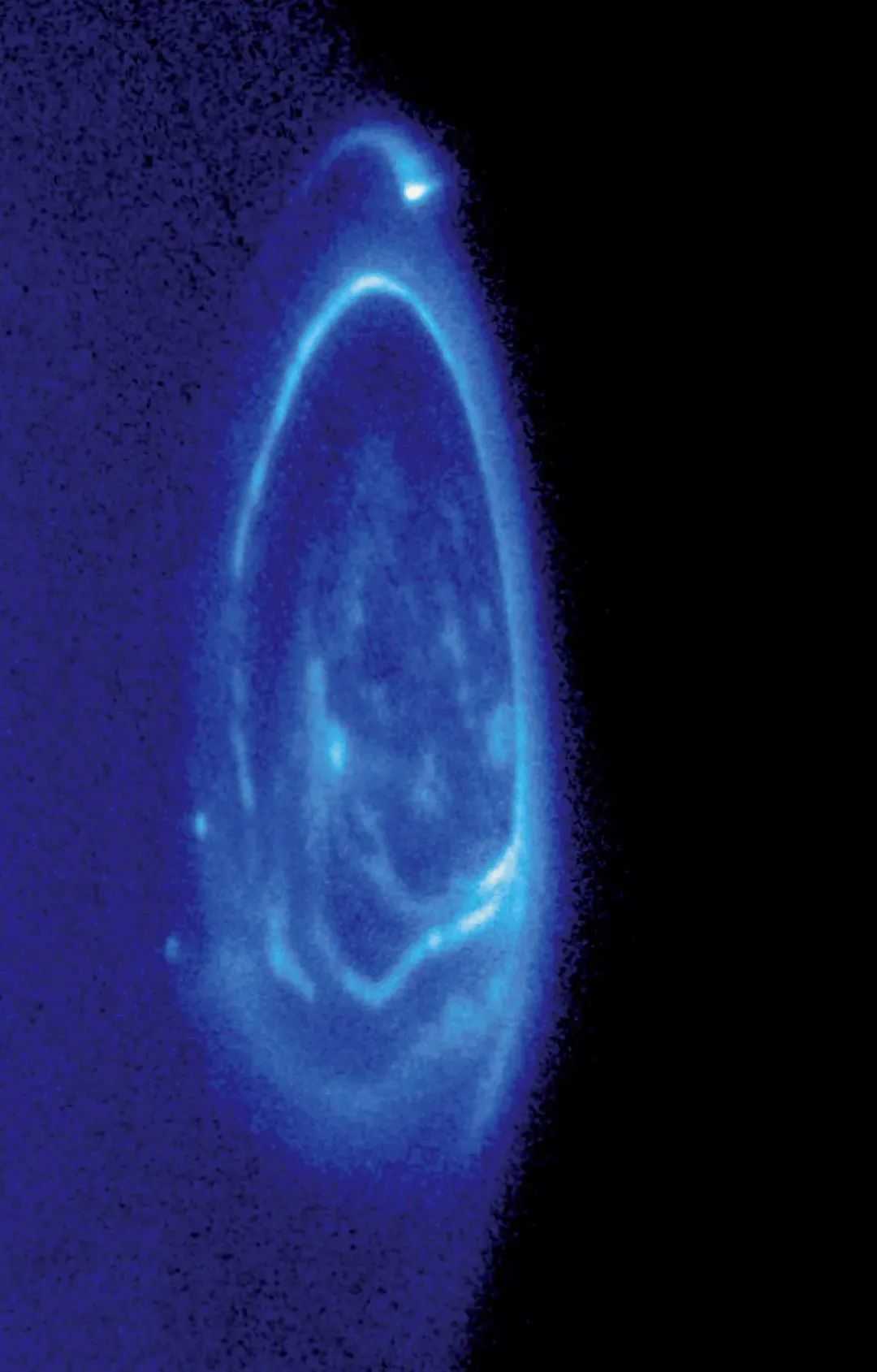
A stunning image captures Jupiter’s auroras—dazzling ultraviolet (UV) rings encircling the planet’s north pole—revealing the dynamic interplay between its powerful magnetic field and its retinue of moons. These celestial light shows, invisible to the naked eye but vivid in UV wavelengths, offer a window into the extreme physics governing the solar system’s largest planet.

The prominent UV rings around Jupiter’s north pole are generated by charged particles accelerated along the planet’s magnetic field lines. Unlike Earth’s auroras, which are primarily fueled by solar wind particles, Jupiter’s auroras derive much of their energy from its own moons, particularly the volcanic moon Io. Io’s intense volcanic activity releases plumes of sulfur and oxygen ions into space, which are rapidly ionized and trapped by Jupiter’s magnetosphere. These ions are then accelerated along magnetic field lines toward the planet’s poles, colliding with atoms in Jupiter’s upper atmosphere and producing the glowing UV rings. The result is a complex interplay of light, with bright spots and streaks marking regions of particularly intense particle bombardment.


In the image, discrete bright spots within the auroral rings stand out, tracing the magnetic field lines connecting Jupiter to its large moons—Io, Europa, Ganymede, and Callisto. Each moon creates a unique "footprint" in the auroras: for example, the connection to Io is particularly strong, producing persistent bright spots that shift as the moon orbits the planet. These moon-driven auroral features are a testament to Jupiter’s role as a gravitational and magnetic powerhouse, shaping the environment of its entire moon system. Observations of these phenomena, often made by space telescopes like Hubble or the Juno spacecraft, help scientists understand the dynamics of Jupiter’s magnetosphere, the composition of its upper atmosphere, and the interaction between planets and their moons.


Jupiter’s auroras are not only a scientific marvel but also a reminder of the diverse ways celestial bodies generate light. While Earth’s auroras are fleeting and colorful, Jupiter’s UV rings are a constant, intense display of cosmic energy. Studying these phenomena deepens our understanding of planetary magnetospheres, space weather, and the transfer of material between planets and their moons. As missions like Juno continue to explore Jupiter, they unravel the mysteries of these glowing rings, shedding light on the complex mechanisms that make the gas giant a dynamic and ever-surprising world.
Latest Stories
Bird Information1 minute readEndemic to New Guinea, the greater bird of paradise (Paradisaea apoda) belongs to the Paradisaeidae family, feasting on fruits and insects. So extraordinary is its beauty that 19th-century European naturalists doubted its existence, suspecting its vividly plumed specimens were fraudulent "mythical creatures."
Health News1 minute readSwitzerland has claimed the top spot in the latest European Health Consumer Index, solidifying its reputation as a leader in healthcare excellence across the continent.
Beauty News1 minute readMadrid-born freelance model Clara López, 27, has gained viral attention with a set of candid life photos captured across Barcelona’s cobblestone streets. The unposed series, shot by photographer friend Lucas Martínez, highlights López’s effortless elegance in everyday moments—from sipping coffee at a sidewalk café to browsing a vintage bookstore. Her 175cm frame, dressed in high-waisted jeans and oversized knit sweaters, blends seamlessly with the city’s bohemian vibe.
Travel News2 minute readNestled in the Vosges Mountains of Haute-Saône, France, the Plateau des Mille Etangs (Thousand Ponds Plateau) is emerging as a top destination for discerning hikers. Shaped by glaciers and human history, this 220 km² region boasts a surreal landscape of lakes, forests, and peat bogs, earning it the nickname "Little Finland" .
Health News1 minute readNestled in a sheltered bay on the eastern shore of Lake Geneva in Switzerland’s Vaud canton, the town of Montreux is framed by the snow-capped Alps, boasting breathtaking scenery. Long celebrated as a wellness retreat with a mild, pleasant climate, it covers 41 square kilometers and is home to around 23,000 residents—an idyllic small town known globally as a "mecca for beauty" and "capital of medical wellness."
Travel News2 minute readPerched on the banks of the Moselle River in Lorraine, France, the Cathédrale Saint-Étienne de Metz stands as a testament to Gothic grandeur and artistic innovation. With 6,500 square meters of stained glass—the largest expanse in France—it has earned the nickname “Lanterne du Bon Dieu” (God’s Lantern), captivating visitors with its ethereal glow and architectural brilliance.
Industry News1 minute readForeign media reported on July 15 that the European Commission has formally withdrawn its plan to impose a digital tax on major tech companies during the latest budget negotiations. The decision is seen as a key compromise in EU-U.S. trade talks, temporarily relieving U.S. tech giants like Apple and Meta from heavy tax pressures, while the EU paves the way for broader trade agreements by adjusting its fiscal strategy.