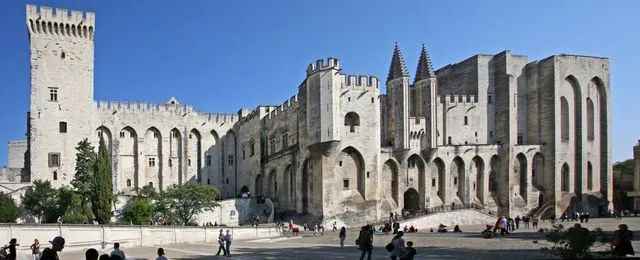
Perched atop the Rocher des Doms overlooking the Rhône River, the Palais des Papes in Avignon, France, stands as the world’s largest Gothic palace and a UNESCO World Heritage Site since 1995 . This architectural marvel, built between 1335 and 1364, served as the seat of the Catholic Church during the Avignon Papacy (1309–1377), a pivotal period when nine popes fled political turmoil in Rome to establish their authority in this southern French city .
Perched atop the Rocher des Doms overlooking the Rhône River, the Palais des Papes in Avignon, France, stands as the world’s largest Gothic palace and a UNESCO World Heritage Site since 1995 . This architectural marvel, built between 1335 and 1364, served as the seat of the Catholic Church during the Avignon Papacy (1309–1377), a pivotal period when nine popes fled political turmoil in Rome to establish their authority in this southern French city .
Constructed in two distinct phases, the palace embodies contrasting styles. The Palais Vieux (Old Palace), commissioned by Pope Benedict XII, reflects his austere personality with fortress-like walls and minimal ornamentation, designed to withstand attacks . In stark contrast, the Palais Neuf (New Palace), overseen by Pope Clement VI and architect Jean de Louvres, exudes opulence with its grand halls, soaring ceilings, and intricate frescoes by artists like Simone Martini and Matteo Giovanetti . The 52-meter-long Grande Chapelle, a masterpiece of Gothic engineering, once hosted lavish ceremonies and musical innovations, including the Ars Nova style .
The palace’s strategic location near the Rhône River facilitated communication across Europe, with messengers reaching London or Rome in under two weeks . However, its role diminished after the papacy returned to Rome in 1377, leading to neglect and later misuse as a military barracks and prison during the French Revolution . Restored since 1906, it now houses a museum showcasing 25 rooms, including the Consistory Hall, Papal Apartments, and the Salle de la Grande Audience, where visitors can marvel at 14th-century artistry .
Today, the Palais des Papes offers immersive experiences, such as the Histopad, a 3D interactive tablet that brings history to life through augmented reality . Its courtyard hosts the renowned Avignon Festival each July, blending medieval grandeur with modern creativity . With its imposing towers, labyrinthine corridors, and sweeping views of the city, the palace remains a symbol of power, faith, and architectural brilliance—a must-visit for travelers seeking to delve into Europe’s medieval past.
Palais des Papes d'Avignon: The World's Largest Gothic Masterpiece
Nestled on the Rocher des Doms overlooking the Rhône River, Avignon’s Palais des Papes reigns as the world’s largest Gothic palace and a UNESCO World Heritage Site since 1995 . Built between 1335 and 1364, this architectural colossus (15,000 sq.m.) served as the seat of the Catholic Church during the Avignon Papacy (1309–1377), a pivotal era when nine popes fled Rome’s political strife to establish their authority in southern France .
Constructed in two distinct phases, the palace showcases contrasting styles. The Palais Vieux (Old Palace), commissioned by Pope Benedict XII, reflects his austere vision with fortress-like walls and minimal ornamentation, designed for defense . In stark contrast, the Palais Neuf (New Palace), overseen by Pope Clement VI and architect Jean de Louvres, exudes opulence with grand halls, soaring ceilings, and intricate frescoes by artists like Simone Martini and Matteo Giovanetti . The 52-meter-long Grande Chapelle, a Gothic engineering marvel, once hosted lavish ceremonies and musical innovations, including the Ars Nova style .
Strategically located near the Rhône, the palace facilitated swift communication across Europe, with messengers reaching London or Rome in under two weeks . However, its decline began after the papacy’s return to Rome in 1377, leading to neglect and misuse as a military barracks and prison during the French Revolution . Restored since 1906, it now houses a museum with 25 open rooms, including the Consistory Hall, Papal Apartments, and the Salle de la Grande Audience, where 14th-century artistry captivates visitors .
Today, the palace offers immersive experiences, such as the Histopad—a 3D interactive tablet that uses augmented reality to reconstruct medieval life . Its courtyard hosts the Avignon Festival each July, blending medieval grandeur with modern creativity . With its imposing towers, labyrinthine corridors, and panoramic city views, the Palais des Papes remains a testament to power, faith, and architectural genius—a timeless icon of Europe’s medieval heritage.