Saturn’s Enceladus: Does an Ocean beneath Ice Harbor Life?


Astro Information
Saturn’s Enceladus: Does an Ocean beneath Ice Harbor Life?

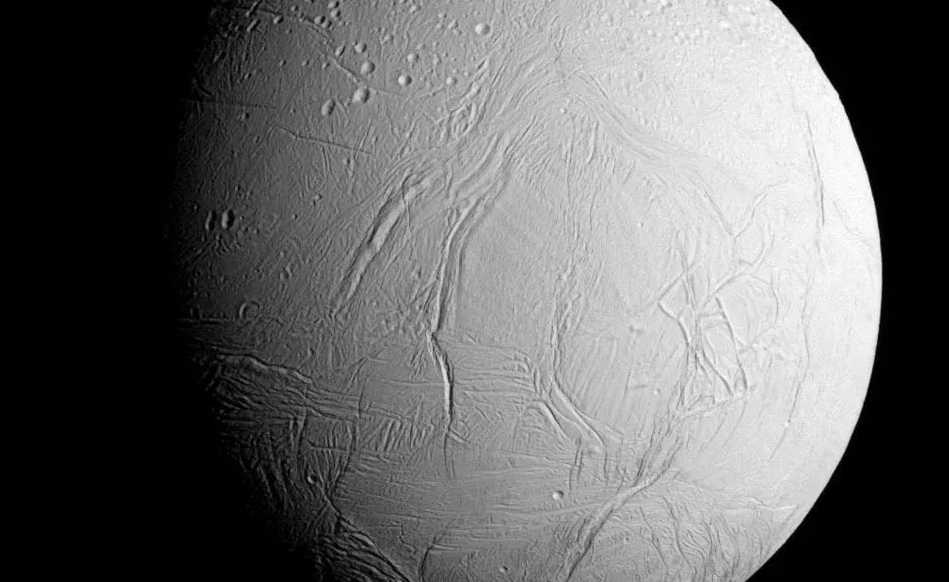
Enceladus, Saturn’s icy moon, harbors a subsurface ocean beneath tiger-stripe fractures that erupt icy particles into space. These geysers form a dense ice cloud over the south pole, feeding Saturn’s faint E ring. The Cassini spacecraft (2004–2017) provided definitive evidence, capturing this true-color, high-resolution image during a close flyby, revealing shadowed ice chasms and active vents.

Geological Mystery: Why Enceladus Thrives While Mimas Slumbers

Enceladus’ "Tiger Stripes"—four parallel fractures each 130 km long—pulse with eruptions, flinging water vapor and ice grains at 800 km/h. Unusually, this activity persists despite Enceladus’ tiny size (504 km diameter). By contrast, similar-sized Mimas lies geologically dead. Scientists suspect tidal heating from Saturn’s gravity flexes Enceladus’ core, generating the warmth needed to sustain its subsurface ocean.


Cassini’s radar revealed a 10–30 km deep ocean beneath a 30–40 km ice crust. The moon’s south pole shows recent surface resurfacing, indicating ongoing activity—unlike most icy moons, which are geologically frozen.

Organic Molecules in Eruptions: Clues to Possible Life

Analysis of Enceladus’ plume particles revealed complex organic molecules, including benzene and long-chain hydrocarbons. These carbon-rich compounds, detected in 2015 by Cassini’s mass spectrometer, are building blocks of life as we know it. While not proof of life, their presence suggests the ocean may have a habitable chemistry:


  • Warm Hydrothermal Vents: Subsurface ocean models predict hydrothermal activity at Enceladus’ seafloor, similar to Earth’s deep-sea vents where life thrives.
  • Energy Sources: Dissolved salts and chemical gradients in the ocean could provide energy for microbial life.


"Enceladus is a top target for astrobiology," says Dr. Linda Spilker, Cassini project scientist. "Its ocean has liquid water, organic materials, and energy sources—three key ingredients for life."


Future missions like NASA’s Enceladus Orbilander (proposed) aim to sample the plume directly, searching for biosignatures. Until then, Enceladus remains a cosmic enigma—an icy moon spraying hints of life into the Saturnian system.

Latest Stories
Industry News1 minute readMicrosoft and the U.S. Idaho National Laboratory (INL) announced a partnership on July 16 to use AI in new nuclear plant licensing, aiming to drastically shorten the process. The move responds to Trump’s executive order to cut nuclear licensing to 18 months, addressing growing energy demands from AI data centers.
Astro Information2 minute readFor millennia, humanity has named the brightest stars, weaving their light into myths and calendars. Today, the International Astronomical Union (IAU) standardizes these names to unite global science, but each moniker still holds cultural treasures. Here’s a journey through the 25 brightest stars—by apparent magnitude—with their IAU-designated names and the stories behind them.
Health News1 minute readNestled in a sheltered bay on the eastern shore of Lake Geneva in Switzerland’s Vaud canton, the town of Montreux is framed by the snow-capped Alps, boasting breathtaking scenery. Long celebrated as a wellness retreat with a mild, pleasant climate, it covers 41 square kilometers and is home to around 23,000 residents—an idyllic small town known globally as a "mecca for beauty" and "capital of medical wellness."
Health News1 minute readSeattle-based global health organization PATH has launched Africa’s largest AI-driven medical research project in Kenya, aiming to test if AI can improve diagnosis and treatment decisions in resource-limited primary care settings. The study, based in Nairobi, has enrolled 9,000 participants.
Astro Information1 minute readNGC 6302, a planetary nebula nicknamed the "Butterfly Nebula," lives up to its floral-insect moniker with wing-like gas plumes spanning 3 light-years. Located 4,000 light-years away in Scorpius, this stellar corpse showcases the dramatic final act of a massive star—now a 250,000°C central star evolving into a white dwarf, its ultraviolet radiation ionizing the surrounding nebula into a kaleidoscopic display.
Travel News2 minute readNestled beneath the natural limestone arch of Pont-d'Arc in France's Ardèche region, the Chauvet-Pont-d'Arc Cave (Grotte Chauvet-Pont-d'Arc) stands as a UNESCO World Heritage Site and one of humanity's most profound artistic treasures. This geological marvel shelters a trove of Paleolithic masterpieces that redefine our understanding of early human creativity.
Industry News1 minute readRecent leaked reports suggest that Apple's upcoming ultra-thin iPhone 17 Air will be equipped with a battery capacity of approximately 2,800 mAh, a figure that not only falls below the industry-standard 3,000 mAh threshold but also smaller than the battery capacities of all models in the current iPhone 16 series.