Scorpionflies: The Insects with a Deceptive 'Scorpion Tail'


Insect Information
Scorpionflies: The Insects with a Deceptive 'Scorpion Tail'

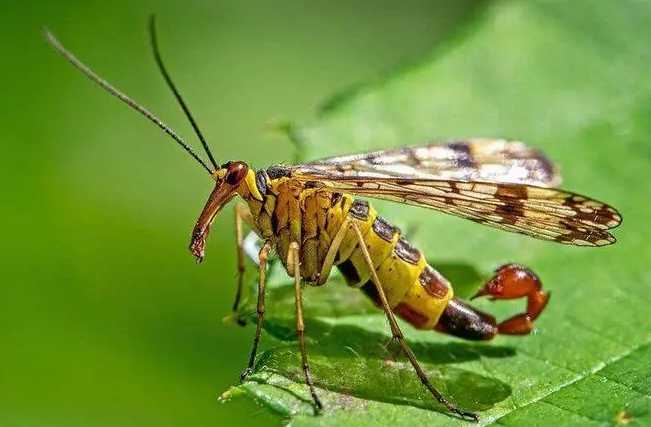
In forests and meadows worldwide, scorpionflies (order Mecoptera) perplex onlookers with a curious feature: a tail that resembles a scorpion’s stinger, but serves an entirely different purpose. Contrary to appearances, this bulbous, curved appendage at the insect’s rear is not a venomous weapon—but rather the male’s elaborate genitalia, a bizarre evolutionary trait that has fascinated entomologists for centuries.


A Misleading Appendage: Form vs. Function
The male scorpionfly’s "tail" is actually an enlarged, segmented abdomen modified into a clasping organ used during mating. Resembling a scorpion’s stinger in shape and positioning, it can curl upward in a threatening pose, yet lacks any venom glands or piercing ability. This mimicry is thought to deter predators, as the illusion of a scorpion’s sting may dissuade birds or small mammals from attacking. Females, meanwhile, have straight, unspecialized abdomens, highlighting the dramatic sexual dimorphism in the species. Despite their intimidating appearance, scorpionflies are harmless to humans, feeding primarily on decaying plant matter, small insects, and even carrion.


Behavior and Evolutionary Significance
Scorpionflies are named for their scorpion-like tail and fly-like wings, which fold over their bodies at rest. During courtship, males use their genitalic "tail" to grasp females, while some species offer nuptial gifts of saliva or prey to attract mates—a behavior rare in insects. Their unique morphology provides insights into evolutionary biology, as the scorpion tail mimicry exemplifies how sexual selection and predator avoidance can shape bizarre traits. Found in temperate regions, they play a role in ecosystems as decomposers and pollinators, though their secretive nature makes them easy to overlook.


For researchers, scorpionflies serve as a reminder that nature’s designs often prioritize survival and reproduction over straightforward functionality. Their deceptive "stinger" proves that in the insect world, even the most fearsome-looking features may hide a surprising purpose. As these quirky insects flutter through the underbrush, their existence challenges our assumptions—showing that sometimes, the most intimidating appendages are anything but weapons.
Latest Stories
Industry News1 minute readMicrosoft and the U.S. Idaho National Laboratory (INL) announced a partnership on July 16 to use AI in new nuclear plant licensing, aiming to drastically shorten the process. The move responds to Trump’s executive order to cut nuclear licensing to 18 months, addressing growing energy demands from AI data centers.
Astro Information2 minute readFor millennia, humanity has named the brightest stars, weaving their light into myths and calendars. Today, the International Astronomical Union (IAU) standardizes these names to unite global science, but each moniker still holds cultural treasures. Here’s a journey through the 25 brightest stars—by apparent magnitude—with their IAU-designated names and the stories behind them.
Health News1 minute readNestled in a sheltered bay on the eastern shore of Lake Geneva in Switzerland’s Vaud canton, the town of Montreux is framed by the snow-capped Alps, boasting breathtaking scenery. Long celebrated as a wellness retreat with a mild, pleasant climate, it covers 41 square kilometers and is home to around 23,000 residents—an idyllic small town known globally as a "mecca for beauty" and "capital of medical wellness."
Health News1 minute readSeattle-based global health organization PATH has launched Africa’s largest AI-driven medical research project in Kenya, aiming to test if AI can improve diagnosis and treatment decisions in resource-limited primary care settings. The study, based in Nairobi, has enrolled 9,000 participants.
Astro Information1 minute readNGC 6302, a planetary nebula nicknamed the "Butterfly Nebula," lives up to its floral-insect moniker with wing-like gas plumes spanning 3 light-years. Located 4,000 light-years away in Scorpius, this stellar corpse showcases the dramatic final act of a massive star—now a 250,000°C central star evolving into a white dwarf, its ultraviolet radiation ionizing the surrounding nebula into a kaleidoscopic display.
Travel News2 minute readNestled beneath the natural limestone arch of Pont-d'Arc in France's Ardèche region, the Chauvet-Pont-d'Arc Cave (Grotte Chauvet-Pont-d'Arc) stands as a UNESCO World Heritage Site and one of humanity's most profound artistic treasures. This geological marvel shelters a trove of Paleolithic masterpieces that redefine our understanding of early human creativity.
Industry News1 minute readRecent leaked reports suggest that Apple's upcoming ultra-thin iPhone 17 Air will be equipped with a battery capacity of approximately 2,800 mAh, a figure that not only falls below the industry-standard 3,000 mAh threshold but also smaller than the battery capacities of all models in the current iPhone 16 series.