The Colorado Potato Beetle (Leptinotarsa decemlineata): A Persistent Agricultural Menace


Insect Information
The Colorado Potato Beetle (Leptinotarsa decemlineata): A Persistent Agricultural Menace

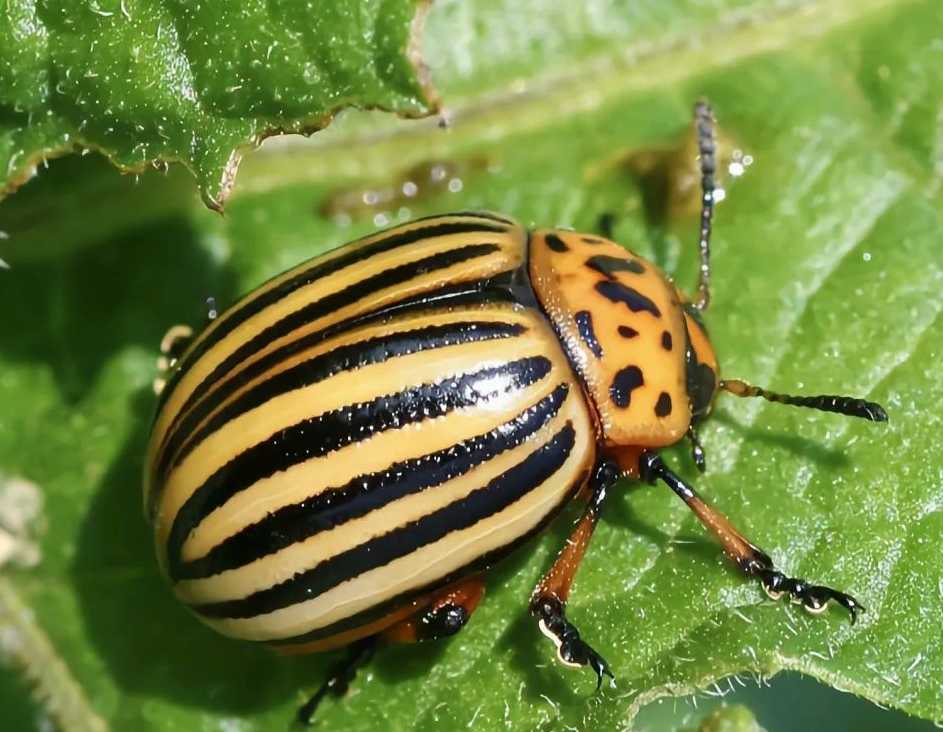
The Colorado potato beetle, scientifically known as Leptinotarsa decemlineata, is a notorious insect pest recognized by its distinctive yellow-orange elytra striped with ten black longitudinal lines. Native to North America, this beetle has earned global infamy for its voracious appetite for potato leaves and its remarkable ability to develop resistance to pesticides, making it a top quarantine target worldwide.

Morphology and Life Cycle

  • Physical Characteristics: Adults measure 7–12 mm, with oval bodies marked by the iconic black-and-yellow stripes. Larvae are plump, bright orange-red, and covered in dark tubercles, while pupae transform in soil before emerging as adults. This vivid coloration serves as a warning to predators, as both larvae and adults secrete toxic compounds from their legs.
  • Rapid Reproduction: Females lay up to 500 eggs on the undersides of potato leaves, and a single generation can develop in as little as 30 days. This short life cycle allows populations to explode, especially in warm, agricultural regions.

Ecological Impact and Agricultural Threat

  • Specialized Feeding Habits: True to its name, the beetle specializes in feeding on solanaceous plants, particularly potatoes (Solanum tuberosum), but also targets tomatoes, eggplants, and peppers. Larvae and adults strip leaves down to the veins, reducing crop yields by up to 90% if left uncontrolled.
  • Pesticide Resistance: Over decades of chemical control, the beetle has evolved resistance to more than 50 insecticides, including organophosphates, pyrethroids, and neonicotinoids. This resistance arises from genetic mutations that enhance detoxification enzymes or alter pesticide targets, making it a model organism for studying insecticide resistance mechanisms.

Global Spread and Quarantine Measures

  • Invasive Journey: Originating in the Rocky Mountains, the beetle followed potato cultivation westward in the 19th century and crossed the Atlantic in the early 1900s. Today, it infests potato farms in Europe, Asia, and North Africa, prompting strict international quarantine protocols.
  • Management Challenges: Farmers employ integrated pest management (IPM) strategies, including crop rotation, biological control (using natural enemies like parasitic wasps), and genetically modified potatoes producing insecticidal proteins. However, the beetle’s adaptability often outpaces these efforts.

Scientific Significance and Cultural Notes

  • Model for Pest Research: The beetle’s genome has been sequenced, aiding studies on insect-plant interactions, pesticide resistance, and evolutionary biology. Its ability to rapidly adapt to new hosts and toxins makes it a critical case study in invasive species management.
  • Cultural References: In popular culture, the beetle symbolizes agricultural adversity, appearing in literature and documentaries about sustainable farming. Its nickname, the "striped bandit," reflects farmers’ frustration with its destructive habits.

Future Outlook and Conservation

As climate change expands suitable habitats for the beetle, researchers race to develop novel control methods, such as RNA interference (RNAi) targeting specific genes or pheromone-based traps to disrupt mating. However, the beetle’s resilience underscores the need for global cooperation in pest management—proof that even a small, striped insect can pose a massive challenge to global food security.


From its humble origins in North American prairies to its status as a worldwide agricultural foe, the Colorado potato beetle exemplifies the complex relationship between humans, plants, and pests. Its story serves as a warning: in the battle against invasive species, adaptability often determines survival—and this striped adversary shows no signs of surrender.
Latest Stories
Health News1 minute readMeasles is an acute rash-causing respiratory infection caused by the measles virus. It spreads primarily through respiratory droplets and eye conjunctiva contact, making it one of the most contagious diseases. Typical symptoms include fever, runny nose, cough, tearing, photophobia, and maculopapular rashes. A small number of patients may develop complications such as pneumonia, laryngitis, otitis media, myocarditis, or encephalitis, with severe cases potentially leading to death.
Travel News2 minute readThe soul of Colmar lies in its half-timbered houses, dating back to the 16th century. These whimsical structures feature exposed wooden frames in geometric patterns, their facades painted in vibrant hues like buttercup yellow and sky blue. Flower-boxed windows and playful figurines adorn the facades, while their reflections dance on the Lauch River, creating the iconic Petite Venise (Little Venice) district. Here, fishermen pilot flower-decked boats, and riverside bistros serve Alsatian specialties like choucroute garnie, evoking scenes from Hayao Miyazaki’s Howl’s Moving Castle.
Health News1 minute readLocated in Pittsburgh, Pennsylvania, the UPMC Mercy Eye & Vision Rehabilitation Hospital spans 38,090 square meters. It integrates architectural design, engineering, interior design, landscape design, structural engineering, and sustainable design, earning it the 2023 Urban Land Institute (ULI) Healthier Places Award.
Health News1 minute readThough less internationally renowned, BNH Hospital stands as another top choice among Thailand’s international hospitals. As the country’s oldest private international hospital, it has served foreign patients longer than any other facility in the region.
Health News1 minute readNestled in a sheltered bay on the eastern shore of Lake Geneva in Switzerland’s Vaud canton, the town of Montreux is framed by the snow-capped Alps, boasting breathtaking scenery. Long celebrated as a wellness retreat with a mild, pleasant climate, it covers 41 square kilometers and is home to around 23,000 residents—an idyllic small town known globally as a "mecca for beauty" and "capital of medical wellness."
Astro Information2 minute readOn a clear, moonless night, a faint band stretches across the sky, gradually resolving into a luminous ribbon as eyes adjust to the dark. This is no ordinary sight: it’s the Milky Way, a grand projection of our galaxy’s 千亿 stars. The galactic plane arcs elegantly across the frame, flanked by the colorful Rho Ophiuchi Nebula on the right and the red-ringed Zeta Ophiuchi Nebula at the top center. Taken in late February from Mauna Kea, Hawaii, the image features the University of Hawaii’s 2.2-meter telescope in the foreground—though you don’t need a volcanic summit to witness this cosmic wonder.
Astro Information2 minute readA Sino-German research team led by the Yunnan Observatory of the Chinese Academy of Sciences has discovered a "super-Earth" orbiting a Sun-like star, marking a breakthrough in exoplanet detection. Named Kepler-725c, the planet has a mass 10 times that of Earth and resides in the habitable zone of its host star, where liquid water—and potentially life—could exist. The findings, published June 3 in Nature Astronomy, represent the first use of transit timing variation (TTV) inversion to identify such a planet in a Sun-like star’s habitable zone .