The Enchanting Audubon's Warbler: A Western North American Wonder


Bird Information
The Enchanting Audubon's Warbler: A Western North American Wonder

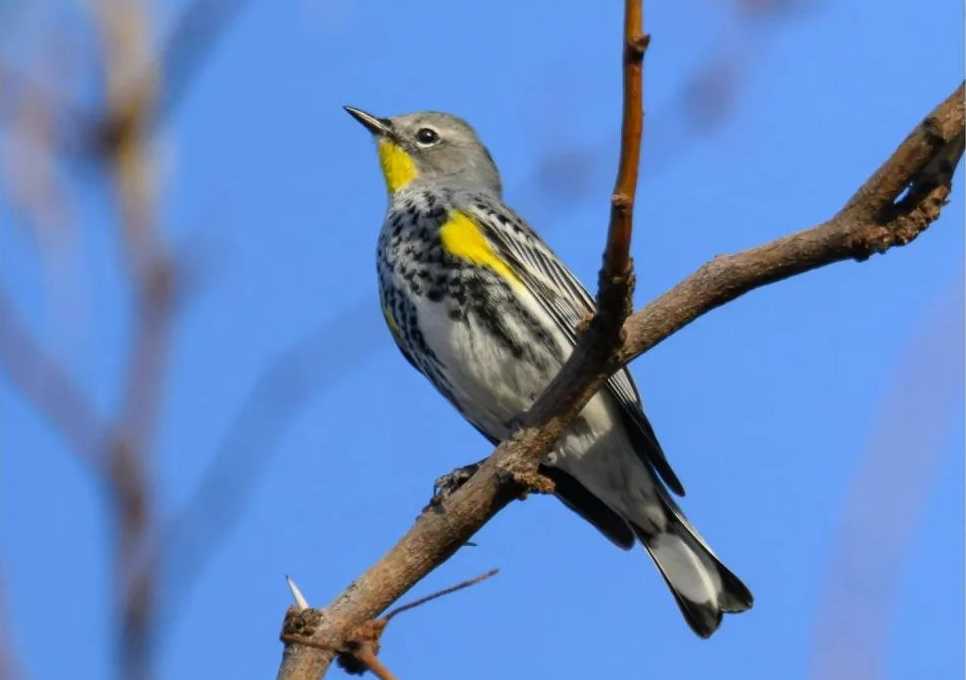
The Audubon's Warbler (Setophaga auduboni) is a captivating small bird that has long intrigued birdwatchers across Western North America. Once considered a distinct species, it's now classified as a subspecies of the Yellow - Rumped Warbler due to hybridization findings.


Measuring about 12 - 14 centimeters in length with a wingspan of 19 - 23 centimeters, these warblers display sexual dimorphism. In spring and summer, adult males are strikingly beautiful. They have a dark back, a vibrant yellow throat, rump, and flank patch, and a black head. Their white wing panels add to their charm. Females, however, have less yellow in their throats and shoulders, with a brown back and white wing bars. Juveniles also have their own unique plumage characteristics. Males have more black in their tails and incomplete wing panels, while females are browner with whitish shoulders and a touch of yellow in the throat.


These warblers are widely distributed across Western North America. They breed in western Canada, the western United States, and parts of Mexico. During winter, they migrate southwards to Central America. Their habitat preferences vary with the seasons. In spring and summer, they are commonly found in coniferous and deciduous forests, where they actively forage for insects, which form the bulk of their diet. Beetles, caterpillars, and bugs are among their favorite prey. As the weather turns colder, they move to more open, shrubby areas and switch to a diet that includes berries, often traveling in flocks. When it comes to breeding, they build cup - shaped nests in trees, and females lay four or five eggs. Their song is a simple trill, and they make a hard "check" call, which helps birdwatchers identify them in the wild. Despite past taxonomic confusion, the Audubon's Warbler continues to grace the Western Hemisphere's landscapes, delighting those lucky enough to spot them.

Latest Stories
Industry News1 minute readMicrosoft and the U.S. Idaho National Laboratory (INL) announced a partnership on July 16 to use AI in new nuclear plant licensing, aiming to drastically shorten the process. The move responds to Trump’s executive order to cut nuclear licensing to 18 months, addressing growing energy demands from AI data centers.
Astro Information2 minute readFor millennia, humanity has named the brightest stars, weaving their light into myths and calendars. Today, the International Astronomical Union (IAU) standardizes these names to unite global science, but each moniker still holds cultural treasures. Here’s a journey through the 25 brightest stars—by apparent magnitude—with their IAU-designated names and the stories behind them.
Health News1 minute readNestled in a sheltered bay on the eastern shore of Lake Geneva in Switzerland’s Vaud canton, the town of Montreux is framed by the snow-capped Alps, boasting breathtaking scenery. Long celebrated as a wellness retreat with a mild, pleasant climate, it covers 41 square kilometers and is home to around 23,000 residents—an idyllic small town known globally as a "mecca for beauty" and "capital of medical wellness."
Health News1 minute readSeattle-based global health organization PATH has launched Africa’s largest AI-driven medical research project in Kenya, aiming to test if AI can improve diagnosis and treatment decisions in resource-limited primary care settings. The study, based in Nairobi, has enrolled 9,000 participants.
Astro Information1 minute readNGC 6302, a planetary nebula nicknamed the "Butterfly Nebula," lives up to its floral-insect moniker with wing-like gas plumes spanning 3 light-years. Located 4,000 light-years away in Scorpius, this stellar corpse showcases the dramatic final act of a massive star—now a 250,000°C central star evolving into a white dwarf, its ultraviolet radiation ionizing the surrounding nebula into a kaleidoscopic display.
Travel News2 minute readNestled beneath the natural limestone arch of Pont-d'Arc in France's Ardèche region, the Chauvet-Pont-d'Arc Cave (Grotte Chauvet-Pont-d'Arc) stands as a UNESCO World Heritage Site and one of humanity's most profound artistic treasures. This geological marvel shelters a trove of Paleolithic masterpieces that redefine our understanding of early human creativity.
Industry News1 minute readRecent leaked reports suggest that Apple's upcoming ultra-thin iPhone 17 Air will be equipped with a battery capacity of approximately 2,800 mAh, a figure that not only falls below the industry-standard 3,000 mAh threshold but also smaller than the battery capacities of all models in the current iPhone 16 series.