The Eye - Catching Great - Tailed Grackle: A Social Avian Sensation


Bird Information
The Eye - Catching Great - Tailed Grackle: A Social Avian Sensation

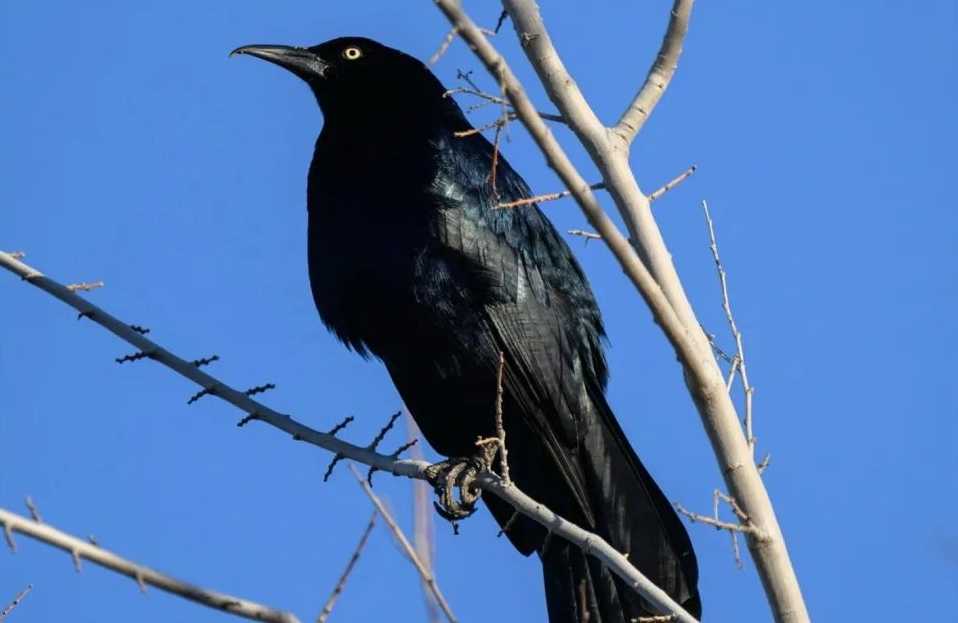
The Great - Tailed Grackle (Quiscalus mexicanus) is a remarkable bird species that has captured the attention of birdwatchers and nature enthusiasts alike. This medium - sized passerine, native to the Americas, is known for its distinct appearance and lively behavior.


Measuring 38 - 46 cm in length, with males weighing 203 - 265 g and females 115 - 142 g, the Great - Tailed Grackle exhibits significant sexual dimorphism. Males are a sight to behold, with their iridescent black plumage that shimmers in purple - blue hues on the head and upper body. Their long, keel - shaped tails, which can be folded vertically, are nearly as long as their bodies. Their bright yellow eyes add a touch of vibrancy to their imposing look. Females, on the other hand, are much smaller and have a more understated brown plumage, with darker wings and tails. Juveniles of both sexes sport brown eyes and plumage similar to females, though with streaks on the breast.


These highly social birds have a wide - ranging habitat. They can be found in a variety of open and semi - open areas, from agricultural fields and feedlots to suburban lawns, golf courses, and city parks. Their range has expanded significantly over the years. Originating from the tropical lowlands of Central and South America, they have spread northwards following urban and agricultural corridors. Today, their territory stretches from northwestern Venezuela and western Colombia and Ecuador in the south, all the way to Minnesota in the north, and from the west coast states like Oregon, Idaho, and California to Florida in the east. Vagrants have even been spotted as far north as southern Canada.


Great - Tailed Grackles are omnivores with diverse foraging habits. They peck at the ground in search of insects, larvae, and seeds. They also wade into shallow water to catch tadpoles, fish, and crustaceans. Additionally, they are not averse to raiding the nests of other birds for eggs and nestlings. During the breeding season, which usually starts in early or mid - April, males put on elaborate displays to attract females. Territorial males defend their areas where multiple females build their nests using woven grass, twigs, and sometimes man - made materials. Females lay 4 - 7 eggs, which they incubate for about 13 - 14 days. The young leave the nest 12 - 17 days after hatching but continue to be fed by their parents for several weeks. Despite being considered pests in some areas due to their habit of eating young crops and fruits, they play an important role in the ecosystem, and their population remains stable, classified as a species of least concern by the IUCN.

Latest Stories
Bird Information1 minute readEndemic to New Guinea, the greater bird of paradise (Paradisaea apoda) belongs to the Paradisaeidae family, feasting on fruits and insects. So extraordinary is its beauty that 19th-century European naturalists doubted its existence, suspecting its vividly plumed specimens were fraudulent "mythical creatures."
Health News1 minute readSwitzerland has claimed the top spot in the latest European Health Consumer Index, solidifying its reputation as a leader in healthcare excellence across the continent.
Beauty News1 minute readMadrid-born freelance model Clara López, 27, has gained viral attention with a set of candid life photos captured across Barcelona’s cobblestone streets. The unposed series, shot by photographer friend Lucas Martínez, highlights López’s effortless elegance in everyday moments—from sipping coffee at a sidewalk café to browsing a vintage bookstore. Her 175cm frame, dressed in high-waisted jeans and oversized knit sweaters, blends seamlessly with the city’s bohemian vibe.
Travel News2 minute readNestled in the Vosges Mountains of Haute-Saône, France, the Plateau des Mille Etangs (Thousand Ponds Plateau) is emerging as a top destination for discerning hikers. Shaped by glaciers and human history, this 220 km² region boasts a surreal landscape of lakes, forests, and peat bogs, earning it the nickname "Little Finland" .
Health News1 minute readNestled in a sheltered bay on the eastern shore of Lake Geneva in Switzerland’s Vaud canton, the town of Montreux is framed by the snow-capped Alps, boasting breathtaking scenery. Long celebrated as a wellness retreat with a mild, pleasant climate, it covers 41 square kilometers and is home to around 23,000 residents—an idyllic small town known globally as a "mecca for beauty" and "capital of medical wellness."
Travel News2 minute readPerched on the banks of the Moselle River in Lorraine, France, the Cathédrale Saint-Étienne de Metz stands as a testament to Gothic grandeur and artistic innovation. With 6,500 square meters of stained glass—the largest expanse in France—it has earned the nickname “Lanterne du Bon Dieu” (God’s Lantern), captivating visitors with its ethereal glow and architectural brilliance.
Industry News1 minute readForeign media reported on July 15 that the European Commission has formally withdrawn its plan to impose a digital tax on major tech companies during the latest budget negotiations. The decision is seen as a key compromise in EU-U.S. trade talks, temporarily relieving U.S. tech giants like Apple and Meta from heavy tax pressures, while the EU paves the way for broader trade agreements by adjusting its fiscal strategy.