The International Space Station Transit: A Fleeting Solar Spectacle


Astro Information
The International Space Station Transit: A Fleeting Solar Spectacle

When the International Space Station (ISS) streaks across the Sun’s disk at 8 km/s, its 0.8-second transit freezes human ingenuity and stellar dynamics on the same cosmic canvas. This rare phenomenon defies the ISS’s usual visibility—typically a bright speck in twilight—occurring only when orbital mechanics align the station, Earth, and Sun with precision.

From "Celestial Speck" to Silhouette: The Science of Visibility

  • Normal Observation: The ISS shines by reflecting sunlight, visible for 30 minutes after sunset or before sunrise when it orbits outside Earth’s shadow. At magnitude -4, it outshines Jupiter, appearing as a 匀速 moving dot.
  • Transit Anomaly: During a transit, the ISS blocks sunlight, forming a silhouette. This requires daytime visibility and a strict alignment of the station’s orbit with the Sun’s disk—occurring only a few times annually over narrow ground paths (e.g., the 200m-wide window in Sant Feliu de Buixelleu, Spain).

The 0.8-Second Shutter Challenge: Technology Behind the Capture

Photographing the transit demands three technical feats:


  1. Equipment Precision: 1/1000+ second exposure cameras with H-α filters to shield against solar glare.
  2. Orbital Prediction: NASA’s Spot the Station tool calculates ISS trajectories with sub-second accuracy.
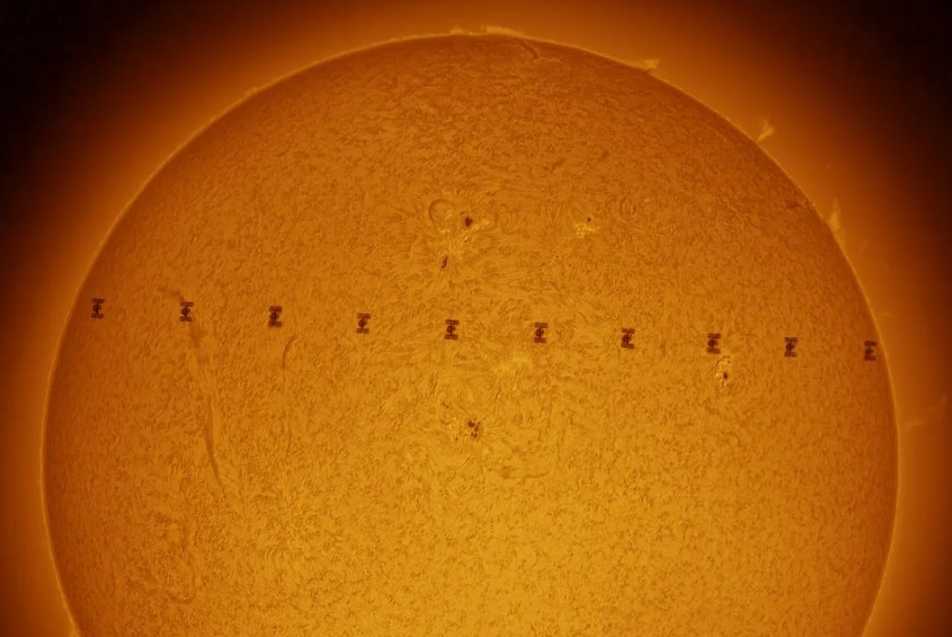
  3. Image Synthesis: This composite merges:
    • Multiple transit frames (capturing the ISS’s T-shaped outline of solar panels and modules).
    • High-res solar activity data (overlaying details like magnetic loops in active regions and chromospheric prominences).


Note: Prominences are 100,000°C plasma arcs extending tens of thousands of km, glowing red in H-α filters.

A Double Exposure of Science and Art

The composite reveals:


  • Active Region Jets: Dark sunspot groups unleash high-energy particles at hundreds of km/s.
  • Prominence Magnetism: Arc-shaped structures trace magnetic fields trapping plasma, evolving with solar dynamics.
  • Orbital Validation: The silhouette’s scale confirms the ISS’s 400km altitude, verifying astrodynamic models.

Extending the Cosmic Ruler: Transits as Scientific Tools

From Venus transits (used to measure the Astronomical Unit in 1761) to exoplanet detections via transit photometry, these events serve as cosmic yardsticks. The ISS transit adds to this legacy: atmospheric turbulence blurs the silhouette, providing data for telescope site 评估.


This Spanish composite—blending steel machinery with a 1.4 million km-diameter star—encapsulates humanity’s place in the cosmos: a 420-ton spacecraft, tiny against the Sun, yet luminous through engineered design.
Latest Stories
Industry News1 minute readMicrosoft and the U.S. Idaho National Laboratory (INL) announced a partnership on July 16 to use AI in new nuclear plant licensing, aiming to drastically shorten the process. The move responds to Trump’s executive order to cut nuclear licensing to 18 months, addressing growing energy demands from AI data centers.
Astro Information2 minute readFor millennia, humanity has named the brightest stars, weaving their light into myths and calendars. Today, the International Astronomical Union (IAU) standardizes these names to unite global science, but each moniker still holds cultural treasures. Here’s a journey through the 25 brightest stars—by apparent magnitude—with their IAU-designated names and the stories behind them.
Health News1 minute readNestled in a sheltered bay on the eastern shore of Lake Geneva in Switzerland’s Vaud canton, the town of Montreux is framed by the snow-capped Alps, boasting breathtaking scenery. Long celebrated as a wellness retreat with a mild, pleasant climate, it covers 41 square kilometers and is home to around 23,000 residents—an idyllic small town known globally as a "mecca for beauty" and "capital of medical wellness."
Health News1 minute readSeattle-based global health organization PATH has launched Africa’s largest AI-driven medical research project in Kenya, aiming to test if AI can improve diagnosis and treatment decisions in resource-limited primary care settings. The study, based in Nairobi, has enrolled 9,000 participants.
Astro Information1 minute readNGC 6302, a planetary nebula nicknamed the "Butterfly Nebula," lives up to its floral-insect moniker with wing-like gas plumes spanning 3 light-years. Located 4,000 light-years away in Scorpius, this stellar corpse showcases the dramatic final act of a massive star—now a 250,000°C central star evolving into a white dwarf, its ultraviolet radiation ionizing the surrounding nebula into a kaleidoscopic display.
Travel News2 minute readNestled beneath the natural limestone arch of Pont-d'Arc in France's Ardèche region, the Chauvet-Pont-d'Arc Cave (Grotte Chauvet-Pont-d'Arc) stands as a UNESCO World Heritage Site and one of humanity's most profound artistic treasures. This geological marvel shelters a trove of Paleolithic masterpieces that redefine our understanding of early human creativity.
Industry News1 minute readRecent leaked reports suggest that Apple's upcoming ultra-thin iPhone 17 Air will be equipped with a battery capacity of approximately 2,800 mAh, a figure that not only falls below the industry-standard 3,000 mAh threshold but also smaller than the battery capacities of all models in the current iPhone 16 series.