The Jewel Beetles (Buprestidae): Nature's Iridescent Gems


Insect Information
The Jewel Beetles (Buprestidae): Nature's Iridescent Gems

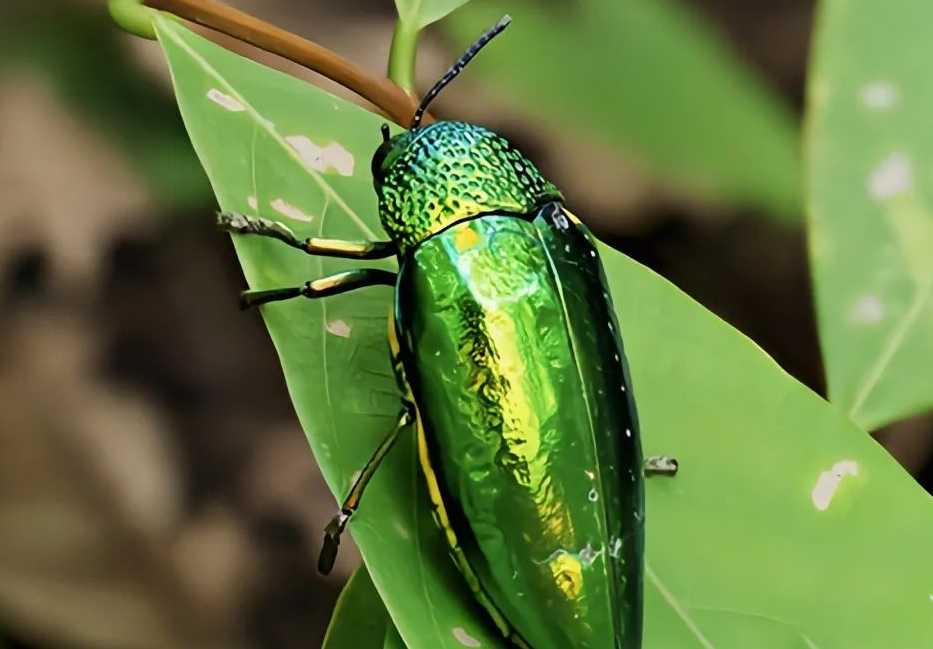
Jewel beetles, members of the family Buprestidae, are renowned for their exoskeletons that shimmer with metallic hues resembling emeralds, sapphires, and gold. This optical marvel arises from structural coloration—microscopic layers on their elytra that refract light, creating vibrant, fade - resistant iridescence. Found across Asia, Africa, and the Americas, these beetles have captivated humans for millennia with their gem - like appearance.


The Science of Structural Color
Unlike pigments, which fade over time, the beetles’ colors stem from nano - scale ridges and layers on their elytra. These structures interfere with light waves, producing hues that shift with viewing angles. For example, species like Chrysochroa fulgidissima display vivid green or blue sheens, while others may appear copper or purple. This adaptation serves dual purposes: camouflage among sunlit foliage and visual signaling during mating. The durability of these colors—remaining vibrant even after the beetle’s death—has made them prized materials for decorative arts.


Cultural Significance and Artistic Use
In Asia, jewel beetle elytra have been used in traditional crafts for centuries. Japanese * tamamono * (decorative art) and Thai * lai ruam mit * embroidery incorporate these iridescent scales to create elaborate patterns. In Myanmar and India, they adorn headdresses, jewelry, and religious artifacts, symbolizing wealth and prosperity. The beetles’ resistance to fading made them valuable substitutes for precious gems in pre - industrial societies. Even today, their wings inspire contemporary fashion and jewelry designs, blending nature’s artistry with human creativity.


Ecological Roles and Modern Research
In ecosystems, jewel beetles play vital roles as pollinators and decomposers. Larvae bore into trees, aiding in wood decay and nutrient cycling, while adults feed on nectar and foliage. Their structural coloration has also become a focus of scientific study: researchers analyze the nano - architecture of their exoskeletons to develop sustainable iridescent materials, energy - efficient optical devices, and even anti - counterfeiting technologies. By mimicking the beetles’ light - manipulating structures, scientists hope to create eco - friendly alternatives to synthetic dyes and pigments.


From ancient adornments to cutting - edge biomimicry, jewel beetles exemplify the intersection of natural beauty and human ingenuity. Their iridescent wings, a product of millions of years of evolution, serve as both a reminder of Earth’s biodiversity and a source of inspiration for sustainable innovation. As we continue to unlock the secrets of their "optical code," these living gems remind us of the infinite wonders hidden in the insect world.
Latest Stories
Bird Information1 minute readEndemic to New Guinea, the greater bird of paradise (Paradisaea apoda) belongs to the Paradisaeidae family, feasting on fruits and insects. So extraordinary is its beauty that 19th-century European naturalists doubted its existence, suspecting its vividly plumed specimens were fraudulent "mythical creatures."
Health News1 minute readSwitzerland has claimed the top spot in the latest European Health Consumer Index, solidifying its reputation as a leader in healthcare excellence across the continent.
Beauty News1 minute readMadrid-born freelance model Clara López, 27, has gained viral attention with a set of candid life photos captured across Barcelona’s cobblestone streets. The unposed series, shot by photographer friend Lucas Martínez, highlights López’s effortless elegance in everyday moments—from sipping coffee at a sidewalk café to browsing a vintage bookstore. Her 175cm frame, dressed in high-waisted jeans and oversized knit sweaters, blends seamlessly with the city’s bohemian vibe.
Travel News2 minute readNestled in the Vosges Mountains of Haute-Saône, France, the Plateau des Mille Etangs (Thousand Ponds Plateau) is emerging as a top destination for discerning hikers. Shaped by glaciers and human history, this 220 km² region boasts a surreal landscape of lakes, forests, and peat bogs, earning it the nickname "Little Finland" .
Health News1 minute readNestled in a sheltered bay on the eastern shore of Lake Geneva in Switzerland’s Vaud canton, the town of Montreux is framed by the snow-capped Alps, boasting breathtaking scenery. Long celebrated as a wellness retreat with a mild, pleasant climate, it covers 41 square kilometers and is home to around 23,000 residents—an idyllic small town known globally as a "mecca for beauty" and "capital of medical wellness."
Travel News2 minute readPerched on the banks of the Moselle River in Lorraine, France, the Cathédrale Saint-Étienne de Metz stands as a testament to Gothic grandeur and artistic innovation. With 6,500 square meters of stained glass—the largest expanse in France—it has earned the nickname “Lanterne du Bon Dieu” (God’s Lantern), captivating visitors with its ethereal glow and architectural brilliance.
Industry News1 minute readForeign media reported on July 15 that the European Commission has formally withdrawn its plan to impose a digital tax on major tech companies during the latest budget negotiations. The decision is seen as a key compromise in EU-U.S. trade talks, temporarily relieving U.S. tech giants like Apple and Meta from heavy tax pressures, while the EU paves the way for broader trade agreements by adjusting its fiscal strategy.