The Ladybug (Coccinellidae): Nature's Spotted Predator and Winter Intruder


Insect Information
The Ladybug (Coccinellidae): Nature's Spotted Predator and Winter Intruder

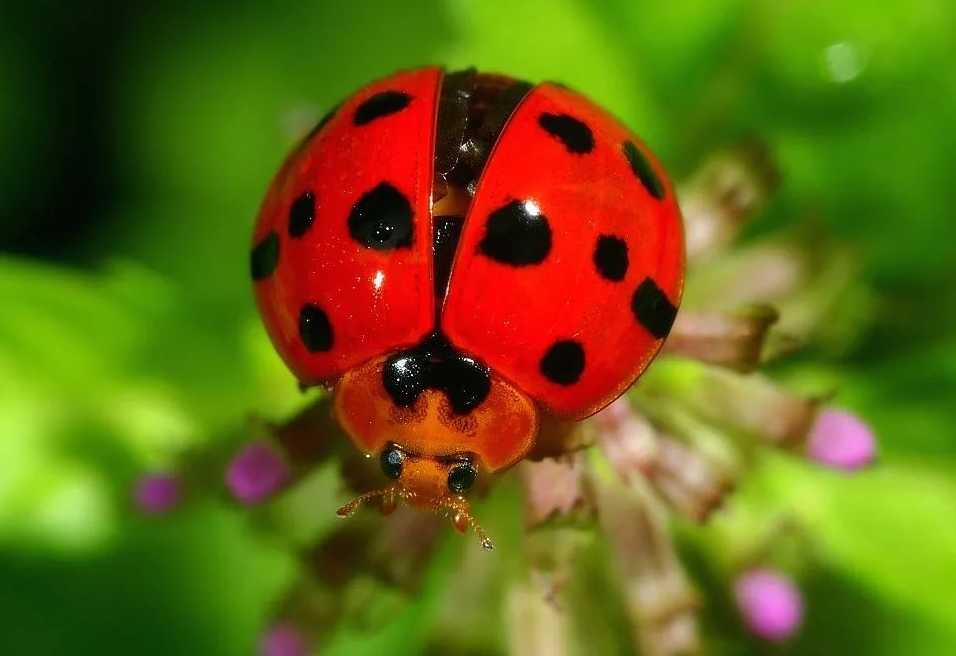
Ladybugs, members of the family Coccinellidae, are iconic insects recognized worldwide for their distinctive spotted exteriors. Typically adorned with red or yellow backs dotted in black, these beetles blend aesthetic appeal with remarkable ecological utility, serving as natural pest controllers in gardens and agricultural fields.

Morphology and Feeding Habits
Their rounded, dome-shaped bodies are adapted for agility and protection, with elytra that shield delicate wings. While the classic red-and-black pattern is most familiar, species vary in coloration—some display yellow, orange, or even black backgrounds with red spots. This diversity often signals chemical defenses: many ladybugs secrete a yellow, foul-smelling hemolymph from their leg joints when threatened, a behavior called reflex bleeding that deters predators. As voracious feeders, adults and larvae consume aphids, mealybugs, and mites, with a single ladybug capable of devouring up to 50 aphids daily—making them invaluable allies in biological pest control.


Seasonal Behavior and Human Interactions
When winter approaches, ladybugs exhibit mass aggregation behavior, seeking shelter in human dwellings to escape the cold. These clusters, sometimes numbering in the hundreds, can invade homes through cracks and crevices, earning them a reputation as unwelcome seasonal guests. While their presence is harmless, the reflex bleeding can stain surfaces, prompting homeowners to seal entry points. In some cultures, ladybugs are considered symbols of good luck, a belief that stems from their role in protecting crops—though their winter invasions often test this sentiment.


Ecological and Cultural Significance
Beyond pest control, ladybugs play a role in pollination and serve as prey for birds and spiders, anchoring food web dynamics. Their life cycle, from egg to larva to pupa to adult, showcases complete metamorphosis, captivating both children and entomologists. In popular culture, they inspire art, literature, and even fashion, while gardeners actively attract them by planting aphid-rich flowers or purchasing them for biological control. Despite their occasional winter intrusions, ladybugs remain beloved icons of nature’s balance—proof that beauty and functionality can coexist in the smallest of creatures.
Latest Stories
Industry News1 minute readMicrosoft and the U.S. Idaho National Laboratory (INL) announced a partnership on July 16 to use AI in new nuclear plant licensing, aiming to drastically shorten the process. The move responds to Trump’s executive order to cut nuclear licensing to 18 months, addressing growing energy demands from AI data centers.
Astro Information2 minute readFor millennia, humanity has named the brightest stars, weaving their light into myths and calendars. Today, the International Astronomical Union (IAU) standardizes these names to unite global science, but each moniker still holds cultural treasures. Here’s a journey through the 25 brightest stars—by apparent magnitude—with their IAU-designated names and the stories behind them.
Health News1 minute readNestled in a sheltered bay on the eastern shore of Lake Geneva in Switzerland’s Vaud canton, the town of Montreux is framed by the snow-capped Alps, boasting breathtaking scenery. Long celebrated as a wellness retreat with a mild, pleasant climate, it covers 41 square kilometers and is home to around 23,000 residents—an idyllic small town known globally as a "mecca for beauty" and "capital of medical wellness."
Health News1 minute readSeattle-based global health organization PATH has launched Africa’s largest AI-driven medical research project in Kenya, aiming to test if AI can improve diagnosis and treatment decisions in resource-limited primary care settings. The study, based in Nairobi, has enrolled 9,000 participants.
Astro Information1 minute readNGC 6302, a planetary nebula nicknamed the "Butterfly Nebula," lives up to its floral-insect moniker with wing-like gas plumes spanning 3 light-years. Located 4,000 light-years away in Scorpius, this stellar corpse showcases the dramatic final act of a massive star—now a 250,000°C central star evolving into a white dwarf, its ultraviolet radiation ionizing the surrounding nebula into a kaleidoscopic display.
Travel News2 minute readNestled beneath the natural limestone arch of Pont-d'Arc in France's Ardèche region, the Chauvet-Pont-d'Arc Cave (Grotte Chauvet-Pont-d'Arc) stands as a UNESCO World Heritage Site and one of humanity's most profound artistic treasures. This geological marvel shelters a trove of Paleolithic masterpieces that redefine our understanding of early human creativity.
Industry News1 minute readRecent leaked reports suggest that Apple's upcoming ultra-thin iPhone 17 Air will be equipped with a battery capacity of approximately 2,800 mAh, a figure that not only falls below the industry-standard 3,000 mAh threshold but also smaller than the battery capacities of all models in the current iPhone 16 series.