The Panda Ant: Deceptive Black-and-White 'Ant' That's Actually a Wingless Wasp


Insect Information
The Panda Ant: Deceptive Black-and-White 'Ant' That's Actually a Wingless Wasp

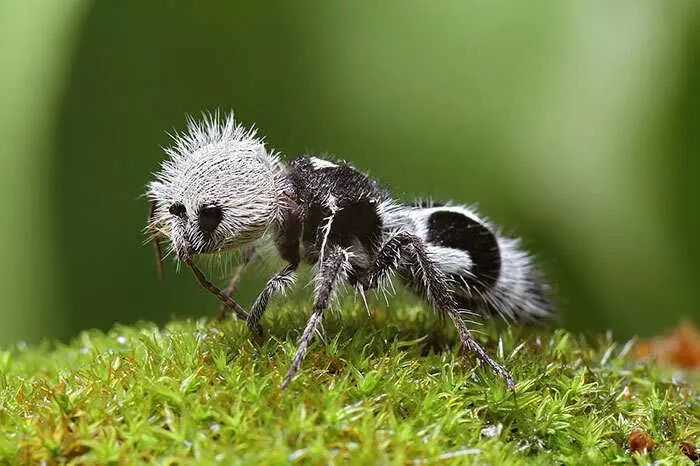
Despite its name and ant-like appearance, the panda ant (Myrmecopsis sp.) is a wingless wasp belonging to the family Mutillidae. Found in arid regions of Chile and parts of Argentina, this striking insect has captivated entomologists with its black-and-white coloration—a pattern that belies its true identity and hides a painful secret.


A Wasp in Ant's Clothing: Anatomy and Adaptations

  • Mimicry and Warning Coloration
    The panda ant’s body measures 8–10 mm, with a velvety black exoskeleton contrasted by white patches on its head, thorax, and abdomen. This bold pattern serves as aposematic coloration, warning predators of its potent sting. Females lack wings, resembling ants to blend into their environment, while males (rarely seen) have wings and a less dramatic color scheme.
  • Venomous Defense Mechanisms
    Despite its small size, the female possesses a powerful stinger, earning it the nickname "cow killer" in some regions (though its sting is not lethal to humans). The venom is designed to subdue prey and deter attackers, making it one of the most feared insects in its habitat.

Life Cycle and Ecological Role

  • Parasitic Reproductive Strategy
    Female panda ants are parasitic, laying their eggs in the nests of other ground-dwelling bees or wasps. Upon hatching, larvae feed on the host’s eggs and larvae, eventually pupating and emerging as adults. This behavior makes them important regulators of bee and wasp populations in arid ecosystems.
  • Nocturnal and Solitary Habits
    Active primarily at night, the panda ant forages for nectar and water. Its dense body hair helps it collect pollen, contributing to plant pollination despite its parasitic lifestyle. Due to its secretive nature, little is known about its mating behaviors or population dynamics.

Scientific Interest and Conservation Status

The panda ant’s unique morphology and life cycle have made it a subject of study for entomologists researching mimicry and parasitic evolution. Its presence in Chile’s arid zones also makes it an indicator of ecosystem health, though habitat destruction from agriculture and urbanization poses potential threats.


While not currently listed as endangered, the species’ reliance on specific host insects and arid habitats highlights its vulnerability to environmental changes. As with many lesser-known invertebrates, preserving the panda ant’s habitat remains crucial for maintaining biodiversity in Earth’s dryland ecosystems.


In the arid landscapes of South America, the panda ant stands as a testament to nature’s deceptive beauty. Its ant-like appearance and wasp-like biology remind us that in the insect world, looks can be profoundly misleading—and that even the most visually striking creatures may hide survival strategies as complex as they are surprising.
Latest Stories
Bird Information1 minute readEndemic to New Guinea, the greater bird of paradise (Paradisaea apoda) belongs to the Paradisaeidae family, feasting on fruits and insects. So extraordinary is its beauty that 19th-century European naturalists doubted its existence, suspecting its vividly plumed specimens were fraudulent "mythical creatures."
Health News1 minute readSwitzerland has claimed the top spot in the latest European Health Consumer Index, solidifying its reputation as a leader in healthcare excellence across the continent.
Beauty News1 minute readMadrid-born freelance model Clara López, 27, has gained viral attention with a set of candid life photos captured across Barcelona’s cobblestone streets. The unposed series, shot by photographer friend Lucas Martínez, highlights López’s effortless elegance in everyday moments—from sipping coffee at a sidewalk café to browsing a vintage bookstore. Her 175cm frame, dressed in high-waisted jeans and oversized knit sweaters, blends seamlessly with the city’s bohemian vibe.
Travel News2 minute readNestled in the Vosges Mountains of Haute-Saône, France, the Plateau des Mille Etangs (Thousand Ponds Plateau) is emerging as a top destination for discerning hikers. Shaped by glaciers and human history, this 220 km² region boasts a surreal landscape of lakes, forests, and peat bogs, earning it the nickname "Little Finland" .
Health News1 minute readNestled in a sheltered bay on the eastern shore of Lake Geneva in Switzerland’s Vaud canton, the town of Montreux is framed by the snow-capped Alps, boasting breathtaking scenery. Long celebrated as a wellness retreat with a mild, pleasant climate, it covers 41 square kilometers and is home to around 23,000 residents—an idyllic small town known globally as a "mecca for beauty" and "capital of medical wellness."
Travel News2 minute readPerched on the banks of the Moselle River in Lorraine, France, the Cathédrale Saint-Étienne de Metz stands as a testament to Gothic grandeur and artistic innovation. With 6,500 square meters of stained glass—the largest expanse in France—it has earned the nickname “Lanterne du Bon Dieu” (God’s Lantern), captivating visitors with its ethereal glow and architectural brilliance.
Industry News1 minute readForeign media reported on July 15 that the European Commission has formally withdrawn its plan to impose a digital tax on major tech companies during the latest budget negotiations. The decision is seen as a key compromise in EU-U.S. trade talks, temporarily relieving U.S. tech giants like Apple and Meta from heavy tax pressures, while the EU paves the way for broader trade agreements by adjusting its fiscal strategy.