The Perseus Cluster (Abell 426): A Cosmic Lab for Dark Matter Studies 240 Million Light-Years Away


Astro Information
The Perseus Cluster (Abell 426): A Cosmic Lab for Dark Matter Studies 240 Million Light-Years Away

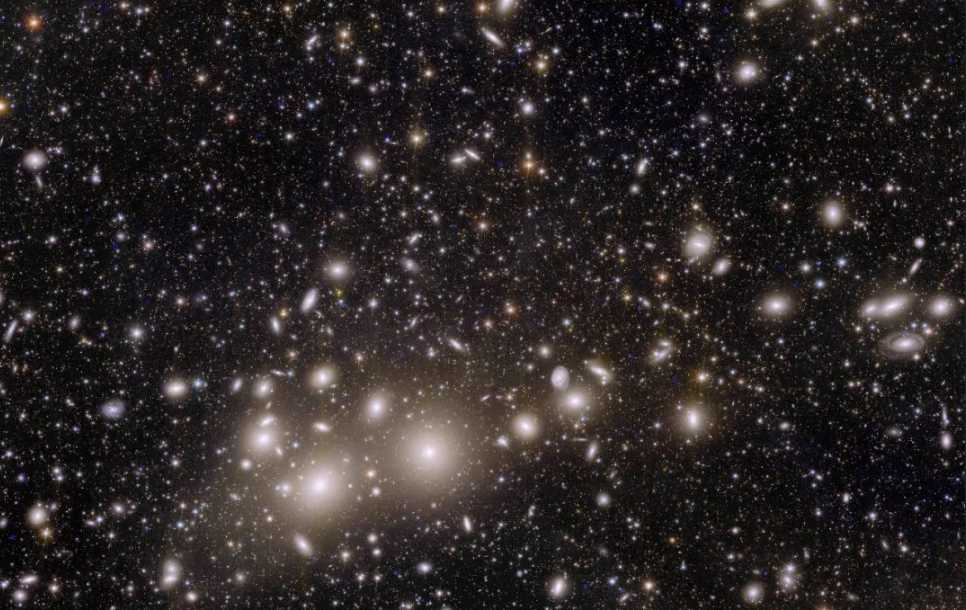
At a distance of 240 million light-years, the Perseus Cluster (Abell 426) stands as a colossal cosmic metropolis, hosting over 1,000 galaxies within its bounds and revealing 100,000 more distant galaxies in its backdrop—some as far as 10 billion light-years from Earth. This gravitational behemoth, captured in detailed astrophotography, serves as a prime laboratory for scientists decoding how dark matter shapes the universe’s structure.

A Galaxy City and Its Cosmic Suburbs

Abell 426 dominates its corner of the constellation Perseus, with its central elliptical galaxy, NGC 1275, acting as a gravitational anchor. The cluster’s 1,000 member galaxies are bound by gravity, forming a structure spanning millions of light-years. But the true marvel lies in its background: deep-sky images reveal 100,000 faint galaxies beyond, their light traveling billions of years to reach Earth. These distant objects serve as cosmic signposts, helping researchers map the invisible web of dark matter.

Dark Matter’s Gravitational Signature in Galaxy Distortions

Scientists study Abell 426 by analyzing how dark matter—comprising ~85% of the universe’s mass—warps space-time. This phenomenon, called gravitational lensing, distorts the light from background galaxies, creating telltale arcs and smudges in images. By mapping these distortions, researchers can:


  • Reconstruct the distribution of dark matter within the cluster.
  • Test theories about dark matter’s gravitational effects on cosmic structure.
  • Validate models of universe evolution, where dark matter acts as the "scaffolding" for galaxy formation.


Computer simulations of Abell 426 show that dark matter’s gravitational pull not only holds the cluster together but also influences the motion of its galaxies and the distribution of hot, X-ray-emitting gas between them. This invisible component’s role is so crucial that without it, the cluster would fly apart.

Peering Through Time to Unlock Cosmic Secrets

It in Abell 426’s field emit light from when the universe was just 3.8 billion years old (current age: ~13.8 billion years). Studying their lensed images allows astronomers to:


  • Compare dark matter distributions in the early universe versus today.
  • Investigate how galaxy clusters like Abell 426 grew over cosmic time.
  • Search for anomalies in gravitational lensing that could hint at new physics beyond standard dark matter models.


As telescopes like the James Webb Space Telescope peer deeper into such clusters, Abell 426 remains a pivotal case study—proving that even in the vastness of space, the key to understanding the universe’s invisible scaffolding lies in the careful analysis of galaxy shapes and their cosmic dance.
Latest Stories
Bird Information1 minute readEndemic to New Guinea, the greater bird of paradise (Paradisaea apoda) belongs to the Paradisaeidae family, feasting on fruits and insects. So extraordinary is its beauty that 19th-century European naturalists doubted its existence, suspecting its vividly plumed specimens were fraudulent "mythical creatures."
Health News1 minute readSwitzerland has claimed the top spot in the latest European Health Consumer Index, solidifying its reputation as a leader in healthcare excellence across the continent.
Beauty News1 minute readMadrid-born freelance model Clara López, 27, has gained viral attention with a set of candid life photos captured across Barcelona’s cobblestone streets. The unposed series, shot by photographer friend Lucas Martínez, highlights López’s effortless elegance in everyday moments—from sipping coffee at a sidewalk café to browsing a vintage bookstore. Her 175cm frame, dressed in high-waisted jeans and oversized knit sweaters, blends seamlessly with the city’s bohemian vibe.
Travel News2 minute readNestled in the Vosges Mountains of Haute-Saône, France, the Plateau des Mille Etangs (Thousand Ponds Plateau) is emerging as a top destination for discerning hikers. Shaped by glaciers and human history, this 220 km² region boasts a surreal landscape of lakes, forests, and peat bogs, earning it the nickname "Little Finland" .
Health News1 minute readNestled in a sheltered bay on the eastern shore of Lake Geneva in Switzerland’s Vaud canton, the town of Montreux is framed by the snow-capped Alps, boasting breathtaking scenery. Long celebrated as a wellness retreat with a mild, pleasant climate, it covers 41 square kilometers and is home to around 23,000 residents—an idyllic small town known globally as a "mecca for beauty" and "capital of medical wellness."
Travel News2 minute readPerched on the banks of the Moselle River in Lorraine, France, the Cathédrale Saint-Étienne de Metz stands as a testament to Gothic grandeur and artistic innovation. With 6,500 square meters of stained glass—the largest expanse in France—it has earned the nickname “Lanterne du Bon Dieu” (God’s Lantern), captivating visitors with its ethereal glow and architectural brilliance.
Industry News1 minute readForeign media reported on July 15 that the European Commission has formally withdrawn its plan to impose a digital tax on major tech companies during the latest budget negotiations. The decision is seen as a key compromise in EU-U.S. trade talks, temporarily relieving U.S. tech giants like Apple and Meta from heavy tax pressures, while the EU paves the way for broader trade agreements by adjusting its fiscal strategy.