The Resplendent Quetzal: Mesoamerica’s Emerald Avian Deity and Symbol of Freedom


Bird Information
The Resplendent Quetzal: Mesoamerica’s Emerald Avian Deity and Symbol of Freedom

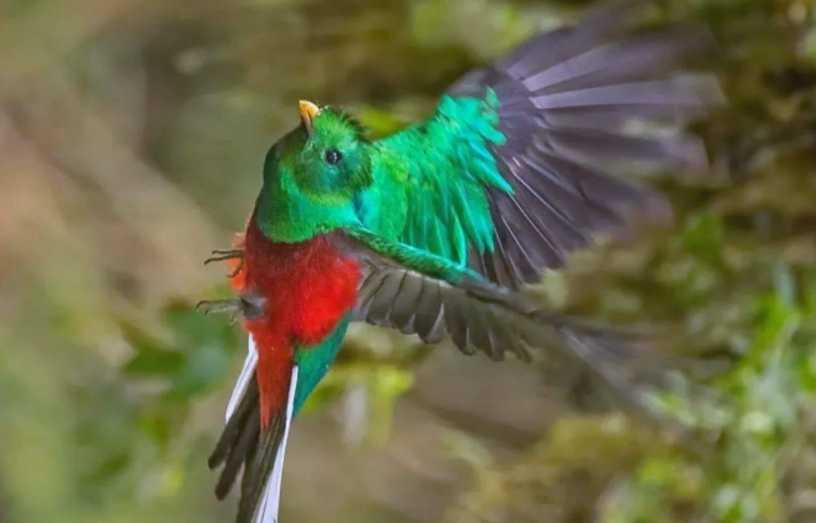
Scientifically named Pharomachrus mocinno, this trogon is endemic to Central American rainforests, measuring 35 cm in length and feasting on insects and fruits. Its cultural significance rivals its biological splendor: in ancient Maya civilization, it was revered as the incarnation of the feathered serpent god Quetzalcoatl, with its emerald plumage reserved exclusively for royalty. Today, it serves as Guatemala’s national bird, embodying freedom and divinity.

The male quetzal is a masterwork of iridescence: its head shimmers in metallic emerald, transitioning to turquoise on the back, with a vivid red breast band. But its crowning glory is the elongated tail feathers, which flow like hand-carved jade ribbons. When sunlight hits its plumage, it refracts a mesmerizing palette of emerald, peacock blue, and jade—"like wearing a living stained-glass window," describes ornithologist Dr. Elida Pérez. This optical magic arises from microscopic feather structures that diffract light, a phenomenon once thought divine by ancient cultures.


In Maya mythology, the quetzal’s refusal to thrive in captivity solidified its role as a freedom symbol. "They’d rather die than be caged," notes conservationist Juan Carlos Mendez, "a trait that mirrors Guatemala’s struggle for independence." Today, deforestation threatens its habitat, but protected areas in Guatemala’s cloud forests offer refuge.


For birdwatchers, spotting a quetzal is a spiritual experience. "When it spreads its tail, those green streamers seem to float without weight," says wildlife photographer Maria Luisa Gómez. "Ancient priests believed the quetzal carried souls to the afterlife—witnessing it, you understand why. It’s not just a bird; it’s a flying poem to nature’s ability to blend art and religion, wrapped in feathers that catch the sun like liquid emeralds."


This avian icon remains a bridge between past and present: its name "quetzal" derives from the Nahuatl word for "tail feather," while its scientific epithet mocinno honors 18th-century naturalist José Celestino Mutis. In both myth and reality, the resplendent quetzal proves that some creatures are so extraordinary, they transcend biology to become living legends.
Latest Stories
Bird Information1 minute readEndemic to New Guinea, the greater bird of paradise (Paradisaea apoda) belongs to the Paradisaeidae family, feasting on fruits and insects. So extraordinary is its beauty that 19th-century European naturalists doubted its existence, suspecting its vividly plumed specimens were fraudulent "mythical creatures."
Health News1 minute readSwitzerland has claimed the top spot in the latest European Health Consumer Index, solidifying its reputation as a leader in healthcare excellence across the continent.
Beauty News1 minute readMadrid-born freelance model Clara López, 27, has gained viral attention with a set of candid life photos captured across Barcelona’s cobblestone streets. The unposed series, shot by photographer friend Lucas Martínez, highlights López’s effortless elegance in everyday moments—from sipping coffee at a sidewalk café to browsing a vintage bookstore. Her 175cm frame, dressed in high-waisted jeans and oversized knit sweaters, blends seamlessly with the city’s bohemian vibe.
Travel News2 minute readNestled in the Vosges Mountains of Haute-Saône, France, the Plateau des Mille Etangs (Thousand Ponds Plateau) is emerging as a top destination for discerning hikers. Shaped by glaciers and human history, this 220 km² region boasts a surreal landscape of lakes, forests, and peat bogs, earning it the nickname "Little Finland" .
Health News1 minute readNestled in a sheltered bay on the eastern shore of Lake Geneva in Switzerland’s Vaud canton, the town of Montreux is framed by the snow-capped Alps, boasting breathtaking scenery. Long celebrated as a wellness retreat with a mild, pleasant climate, it covers 41 square kilometers and is home to around 23,000 residents—an idyllic small town known globally as a "mecca for beauty" and "capital of medical wellness."
Travel News2 minute readPerched on the banks of the Moselle River in Lorraine, France, the Cathédrale Saint-Étienne de Metz stands as a testament to Gothic grandeur and artistic innovation. With 6,500 square meters of stained glass—the largest expanse in France—it has earned the nickname “Lanterne du Bon Dieu” (God’s Lantern), captivating visitors with its ethereal glow and architectural brilliance.
Industry News1 minute readForeign media reported on July 15 that the European Commission has formally withdrawn its plan to impose a digital tax on major tech companies during the latest budget negotiations. The decision is seen as a key compromise in EU-U.S. trade talks, temporarily relieving U.S. tech giants like Apple and Meta from heavy tax pressures, while the EU paves the way for broader trade agreements by adjusting its fiscal strategy.