The Secretarybird: Africa’s Majestic Serpent-Hunter and Walking Raptor


Bird Information
The Secretarybird: Africa’s Majestic Serpent-Hunter and Walking Raptor

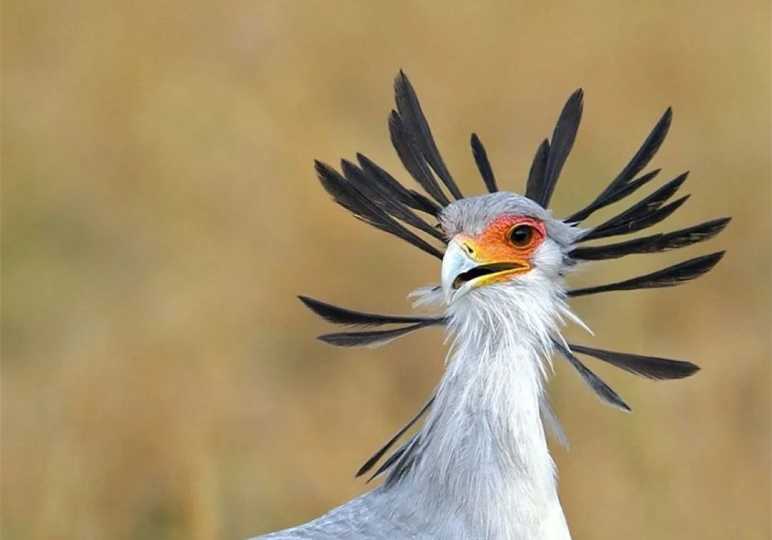
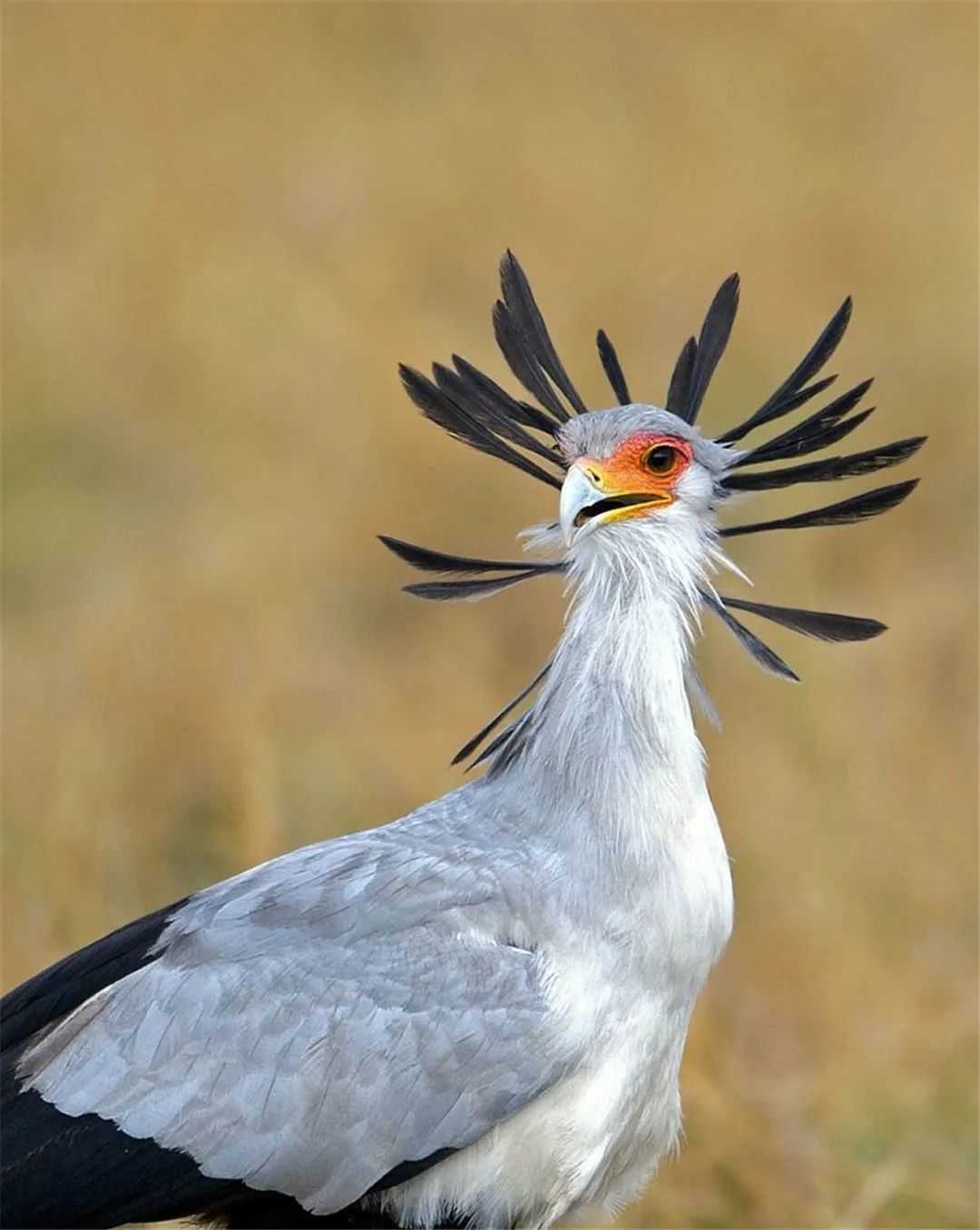
Scientifically named Sagittarius serpentarius, this iconic raptor of sub-Saharan Africa belongs to the family Sagittariidae, standing 1.2–1.5 meters tall with a 2.1-meter wingspan. Renowned for its long legs and terrestrial lifestyle, it earns the nickname "African marching eagle," covering 20–30 kilometers daily on foot. Its name stems from the 20 black crest feathers on its head, resembling the quill pens once tucked behind secretaries’ ears—feathers that erect into a dramatic fan when the bird is agitated, framed by vivid orange-red bare skin around the eyes.
The Secretarybird: Africa’s Majestic Serpent-Hunter and Walking Raptor


Scientifically named Sagittarius serpentarius, this iconic raptor of sub-Saharan Africa belongs to the family Sagittariidae, standing 1.2–1.5 meters tall with a 2.1-meter wingspan. Renowned for its long legs and terrestrial lifestyle, it earns the nickname "African marching eagle," covering 20–30 kilometers daily on foot. Its name stems from the 20 black crest feathers on its head, resembling the quill pens once tucked behind secretaries’ ears—feathers that erect into a dramatic fan when the bird is agitated, framed by vivid orange-red bare skin around the eyes.

Source: Images from the Internet, if there is any infringement, please contact the removal of


"The secretarybird’s appearance defies raptor stereotypes," notes ornithologist Dr. Amara Okafor. "Where others soar, it strides across savannas, its long legs adapted for stomping snakes. Those crest feathers aren’t just ornamental; they signal mood, transforming the bird from elegant to imposing in an instant." Its gray plumage, accented by white wing patches and black thigh feathers, contrasts with a hooked yellow bill—evolution’s perfect tool for dispatching venomous prey.


Native to grasslands and open woodlands, the secretarybird hunts by trampling vegetation to flush out snakes, lizards, and small mammals. "Watching it dance on prey is a marvel," says wildlife biologist James Mwangi. "Each stomp is precise, like a martial artist delivering calculated blows." This unique hunting strategy has inspired African folklore, where the bird is seen as a symbol of wisdom and protection.


Conservationists have noted declines due to habitat loss and pesticide use, though protected areas in Kenya and South Africa support healthy populations. For safari-goers, spotting a secretarybird striding across the plains is a rare privilege: "Its silhouette against the horizon is unforgettable—long legs, crest flared, as if nature painted a walking exclamation mark on the savanna," describes photographer Marcus Westberg.


In avian biology, the secretarybird stands alone: the only raptor adapted for long-distance walking. "Its anatomy is a study in evolutionary compromise," adds Okafor. "Those legs enable marathon treks but limit aerial agility, yet the trade-off works—few predators can match its snake-hunting prowess." As both a biological oddity and a cultural icon, the secretarybird embodies Africa’s wild spirit: "It’s not just a bird; it’s a living legend, a creature so extraordinary it seems to bridge the gap between reality and myth," says Mwangi. "In the vast African landscape, the secretarybird marches on—part hunter, part poet, and entirely nature’s masterpiece."

Latest Stories
Health News1 minute readMeasles is an acute rash-causing respiratory infection caused by the measles virus. It spreads primarily through respiratory droplets and eye conjunctiva contact, making it one of the most contagious diseases. Typical symptoms include fever, runny nose, cough, tearing, photophobia, and maculopapular rashes. A small number of patients may develop complications such as pneumonia, laryngitis, otitis media, myocarditis, or encephalitis, with severe cases potentially leading to death.
Travel News2 minute readThe soul of Colmar lies in its half-timbered houses, dating back to the 16th century. These whimsical structures feature exposed wooden frames in geometric patterns, their facades painted in vibrant hues like buttercup yellow and sky blue. Flower-boxed windows and playful figurines adorn the facades, while their reflections dance on the Lauch River, creating the iconic Petite Venise (Little Venice) district. Here, fishermen pilot flower-decked boats, and riverside bistros serve Alsatian specialties like choucroute garnie, evoking scenes from Hayao Miyazaki’s Howl’s Moving Castle.
Health News1 minute readLocated in Pittsburgh, Pennsylvania, the UPMC Mercy Eye & Vision Rehabilitation Hospital spans 38,090 square meters. It integrates architectural design, engineering, interior design, landscape design, structural engineering, and sustainable design, earning it the 2023 Urban Land Institute (ULI) Healthier Places Award.
Health News1 minute readThough less internationally renowned, BNH Hospital stands as another top choice among Thailand’s international hospitals. As the country’s oldest private international hospital, it has served foreign patients longer than any other facility in the region.
Health News1 minute readNestled in a sheltered bay on the eastern shore of Lake Geneva in Switzerland’s Vaud canton, the town of Montreux is framed by the snow-capped Alps, boasting breathtaking scenery. Long celebrated as a wellness retreat with a mild, pleasant climate, it covers 41 square kilometers and is home to around 23,000 residents—an idyllic small town known globally as a "mecca for beauty" and "capital of medical wellness."
Astro Information2 minute readOn a clear, moonless night, a faint band stretches across the sky, gradually resolving into a luminous ribbon as eyes adjust to the dark. This is no ordinary sight: it’s the Milky Way, a grand projection of our galaxy’s 千亿 stars. The galactic plane arcs elegantly across the frame, flanked by the colorful Rho Ophiuchi Nebula on the right and the red-ringed Zeta Ophiuchi Nebula at the top center. Taken in late February from Mauna Kea, Hawaii, the image features the University of Hawaii’s 2.2-meter telescope in the foreground—though you don’t need a volcanic summit to witness this cosmic wonder.
Astro Information2 minute readA Sino-German research team led by the Yunnan Observatory of the Chinese Academy of Sciences has discovered a "super-Earth" orbiting a Sun-like star, marking a breakthrough in exoplanet detection. Named Kepler-725c, the planet has a mass 10 times that of Earth and resides in the habitable zone of its host star, where liquid water—and potentially life—could exist. The findings, published June 3 in Nature Astronomy, represent the first use of transit timing variation (TTV) inversion to identify such a planet in a Sun-like star’s habitable zone .