The Wasp Mantisfly: A Hybrid Predator That's Neither Mantis Nor Wasp


Insect Information
The Wasp Mantisfly: A Hybrid Predator That's Neither Mantis Nor Wasp

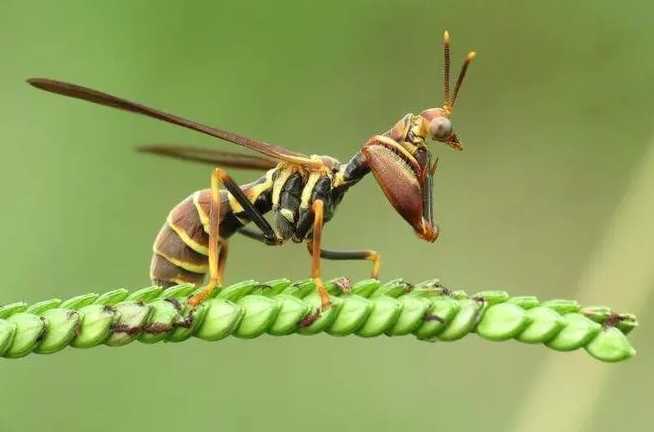
In the tropical and subtropical regions of the world, the wasp mantisfly (Climaciella brunnea) perplexes observers with its split identity: the front half resembles a praying mantis, while the rear mimics a wasp. This insect, part of the family Mantispidae, is a master of evolutionary mimicry, blending features of two fearsome species to create a creature that defies easy classification.


A Dual Identity for Survival
The mantisfly’s head and thorax are almost identical to those of a mantis, complete with triangular head, bulging compound eyes, and raptorial forelegs adapted for seizing prey. These front legs, often held in the classic "praying" pose, allow it to ambush small insects with the same precision as its namesake. The abdomen, however, tells a different story: it narrows into a wasp-like waist and sports yellow and black striped patterns, mimicking the aposematic coloration of stinging wasps. This dual mimicry serves a twofold purpose: the mantis-like front scares off prey, while the wasp-like rear wards off predators, who avoid the perceived threat of a venomous sting.


A Unique Life Cycle and Ecological Niche
Despite its intimidating appearance, the mantisfly is harmless to humans, lacking both the mantis’ powerful bite and the wasp’s stinger. As larvae, they are parasitic, hitching rides on spiders to infiltrate their egg sacs and feed on developing spiderlings—a strategy that sets them apart from both mantises and wasps. Adults feed on nectar and small insects, using their mantis-like legs to capture prey. Found in regions like North America and Southeast Asia, they thrive in gardens and wooded areas, where their hybrid appearance allows them to blend into both predator and prey communities.


For entomologists, the wasp mantisfly is a textbook example of batesian mimicry and convergent evolution, where unrelated species develop similar traits for survival. Its existence challenges our assumptions about insect classifications, proving that nature often prioritizes function over taxonomy. As this strange hybrid flutters between flowers, its mismatched body serves as a reminder that in the animal kingdom, the most effective survival strategies often emerge from the unlikeliest combinations.

Latest Stories
Bird Information1 minute readEndemic to New Guinea, the greater bird of paradise (Paradisaea apoda) belongs to the Paradisaeidae family, feasting on fruits and insects. So extraordinary is its beauty that 19th-century European naturalists doubted its existence, suspecting its vividly plumed specimens were fraudulent "mythical creatures."
Health News1 minute readSwitzerland has claimed the top spot in the latest European Health Consumer Index, solidifying its reputation as a leader in healthcare excellence across the continent.
Beauty News1 minute readMadrid-born freelance model Clara López, 27, has gained viral attention with a set of candid life photos captured across Barcelona’s cobblestone streets. The unposed series, shot by photographer friend Lucas Martínez, highlights López’s effortless elegance in everyday moments—from sipping coffee at a sidewalk café to browsing a vintage bookstore. Her 175cm frame, dressed in high-waisted jeans and oversized knit sweaters, blends seamlessly with the city’s bohemian vibe.
Travel News2 minute readNestled in the Vosges Mountains of Haute-Saône, France, the Plateau des Mille Etangs (Thousand Ponds Plateau) is emerging as a top destination for discerning hikers. Shaped by glaciers and human history, this 220 km² region boasts a surreal landscape of lakes, forests, and peat bogs, earning it the nickname "Little Finland" .
Health News1 minute readNestled in a sheltered bay on the eastern shore of Lake Geneva in Switzerland’s Vaud canton, the town of Montreux is framed by the snow-capped Alps, boasting breathtaking scenery. Long celebrated as a wellness retreat with a mild, pleasant climate, it covers 41 square kilometers and is home to around 23,000 residents—an idyllic small town known globally as a "mecca for beauty" and "capital of medical wellness."
Travel News2 minute readPerched on the banks of the Moselle River in Lorraine, France, the Cathédrale Saint-Étienne de Metz stands as a testament to Gothic grandeur and artistic innovation. With 6,500 square meters of stained glass—the largest expanse in France—it has earned the nickname “Lanterne du Bon Dieu” (God’s Lantern), captivating visitors with its ethereal glow and architectural brilliance.
Industry News1 minute readForeign media reported on July 15 that the European Commission has formally withdrawn its plan to impose a digital tax on major tech companies during the latest budget negotiations. The decision is seen as a key compromise in EU-U.S. trade talks, temporarily relieving U.S. tech giants like Apple and Meta from heavy tax pressures, while the EU paves the way for broader trade agreements by adjusting its fiscal strategy.