The Yeti Crab: Deep-Sea Marvel Renowned for Its Golden-Haired Legs


Insect Information
The Yeti Crab: Deep-Sea Marvel Renowned for Its Golden-Haired Legs

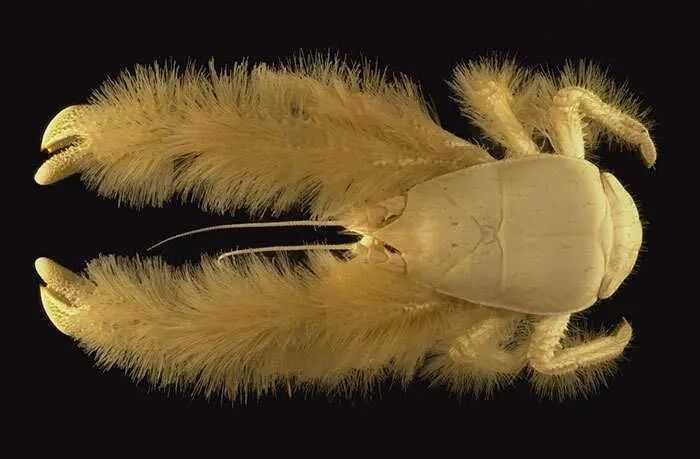
Also known as the Hoff crab, the yeti crab (Kiwa hirsuta) has captivated marine biologists with its most striking feature: legs and claws entirely covered in dense, golden bristles. Discovered in 2005 near hydrothermal vents in the South Pacific, this crustacean belongs to the family Kiwidae and thrives in some of the ocean’s most extreme environments.


Anatomy and Adaptations for Life in the Abyss

  • Golden Bristles as a Survival Tool
    The crab’s hairy appendages are not fur but specialized setae (bristles) that host symbiotic bacteria. These bacteria convert toxic chemicals from hydrothermal vents—such as hydrogen sulfide—into energy through chemosynthesis, forming the base of the crab’s food chain. The golden color may result from mineral deposits on the setae, providing both protection and a surface for bacterial growth.
  • Blind and Bald in the Dark
    Lacking functional eyes, the yeti crab relies on sensory hairs to navigate the pitch-black depths. Its flattened body and strong claws allow it to cling to vent chimneys, while its feathery gills extract oxygen from superheated, mineral-rich water. Growing up to 15 centimeters, it is one of the few animals capable of surviving near 400°C vent plumes.

Ecology and Behavior in Hydrothermal Ecosystems

  • A Unique Symbiotic Relationship
    The crab actively tends to its bacterial gardens, waving its legs to circulate nutrient-rich water and grooming the setae to remove debris. In return, it feeds on the bacteria, making it a rare example of a crustacean relying primarily on chemosynthesis rather than predation or scavenging.
  • Reproduction and Distribution
    Females carry eggs beneath their abdomens, protecting them from toxic vent fluids. The species has been found in multiple vent fields, including the East Scotia Ridge and the Mariana Trench, though its exact distribution remains unclear due to the inaccessibility of its habitat.

Scientific Significance and Conservation

The yeti crab’s discovery revolutionized understanding of deep-sea ecosystems, proving life can thrive in environments once thought uninhabitable. Its symbiotic relationship with bacteria offers insights into astrobiology, inspiring theories about life on other planets with extreme conditions.


While not currently endangered, the species faces potential threats from deep-sea mining, which could destroy hydrothermal vent habitats. Scientists advocate for the establishment of marine protected areas around vent fields, highlighting the need to preserve these unique ecosystems before their secrets are lost.


In the pitch-black depths where sunlight never reaches, the yeti crab stands as a testament to nature’s ability to craft life in the most unlikely places. Its golden-haired form, glowing in the submarine darkness, reminds humanity that the ocean’s mysteries are far from fully explored—and that every discovery holds lessons for understanding the limits of life itself.

Latest Stories
Bird Information1 minute readEndemic to New Guinea, the greater bird of paradise (Paradisaea apoda) belongs to the Paradisaeidae family, feasting on fruits and insects. So extraordinary is its beauty that 19th-century European naturalists doubted its existence, suspecting its vividly plumed specimens were fraudulent "mythical creatures."
Health News1 minute readSwitzerland has claimed the top spot in the latest European Health Consumer Index, solidifying its reputation as a leader in healthcare excellence across the continent.
Beauty News1 minute readMadrid-born freelance model Clara López, 27, has gained viral attention with a set of candid life photos captured across Barcelona’s cobblestone streets. The unposed series, shot by photographer friend Lucas Martínez, highlights López’s effortless elegance in everyday moments—from sipping coffee at a sidewalk café to browsing a vintage bookstore. Her 175cm frame, dressed in high-waisted jeans and oversized knit sweaters, blends seamlessly with the city’s bohemian vibe.
Travel News2 minute readNestled in the Vosges Mountains of Haute-Saône, France, the Plateau des Mille Etangs (Thousand Ponds Plateau) is emerging as a top destination for discerning hikers. Shaped by glaciers and human history, this 220 km² region boasts a surreal landscape of lakes, forests, and peat bogs, earning it the nickname "Little Finland" .
Health News1 minute readNestled in a sheltered bay on the eastern shore of Lake Geneva in Switzerland’s Vaud canton, the town of Montreux is framed by the snow-capped Alps, boasting breathtaking scenery. Long celebrated as a wellness retreat with a mild, pleasant climate, it covers 41 square kilometers and is home to around 23,000 residents—an idyllic small town known globally as a "mecca for beauty" and "capital of medical wellness."
Travel News2 minute readPerched on the banks of the Moselle River in Lorraine, France, the Cathédrale Saint-Étienne de Metz stands as a testament to Gothic grandeur and artistic innovation. With 6,500 square meters of stained glass—the largest expanse in France—it has earned the nickname “Lanterne du Bon Dieu” (God’s Lantern), captivating visitors with its ethereal glow and architectural brilliance.
Industry News1 minute readForeign media reported on July 15 that the European Commission has formally withdrawn its plan to impose a digital tax on major tech companies during the latest budget negotiations. The decision is seen as a key compromise in EU-U.S. trade talks, temporarily relieving U.S. tech giants like Apple and Meta from heavy tax pressures, while the EU paves the way for broader trade agreements by adjusting its fiscal strategy.